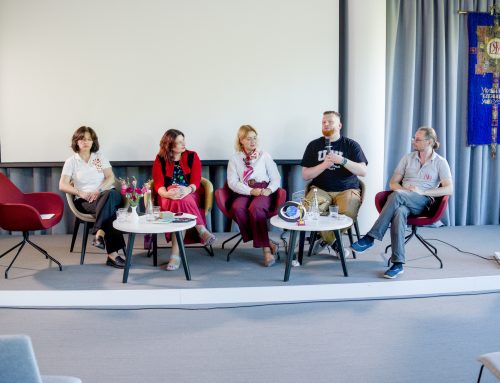
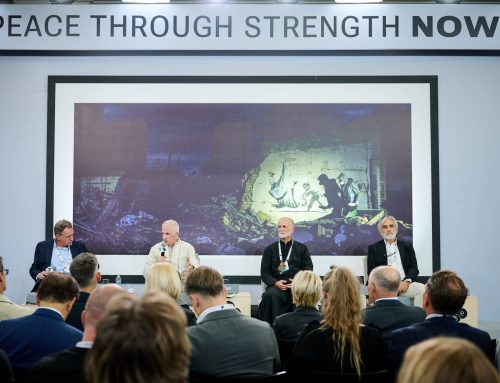
Religious leaders, scholars, artists, and diplomats from various countries took part in a three-day conference, “Revolutions of Hope: Resilience and Recovery in Ukraine,” from 6 to 8 March at the University of Notre Dame in the USA. The conference was timed to mark the launch of the Ukrainian Studies Hub at Notre Dame’s Nanovic Institute and aimed at consolidating the potential of international experts and researchers to reflect on the significance and role of Ukraine in the world in the context of the fight against Russian aggression and the ideology of racism.
Greeting the participants of the conference, President of Notre Dame Fr. Robert Dowd strongly affirmed continuing support for the people of Ukraine.
“We know that this war, triggered by the aggression of Russia’s leader, has gone on for far too long — more than three years now — and the people of Ukraine continue to courageously defend themselves, defying all odds. We here at Notre Dame stand with the people of Ukraine and offer them our full support,” said Fr. Dowd to applause from the audience.
“We all want peace. There’s no doubt about that. But a sustainable peace, it’s just not possible if the wishes of the Ukrainian people are not respected. A sustainable peace is not possible if aggression is seen to be rewarded. Might must never make right. Military might must never give any country the right to invade and occupy another country,” Fr. Dowd added.

President of Notre Dame Fr. Robert Dowd. Photography by Matt Cashore
Volodymyr Turchynovskyy, Dean of the UCU Social Sciences Faculty, was part of the organizing committee for the inaugural conference: “This conference is a very important and unique interdisciplinary and multidimensional event. It’s hard to recall an academic event at such a level in recent decades in the USA with such a deep and professional focus on the theme of Ukraine and its role in the world. It’s very important that 250 participants over a three-day period focused on the theme of Ukraine, the maturity, courage, and solidarity of Ukrainian society, which not only has not lost hope but is also a source of hope and a symbol of freedom for Europe and for the world.”
The conference was the start of more systematic cooperation between UCU and the University of Notre Dame. The range of the partnership of the two universities is expanding and developing, and this three-day event, which marked the opening of the Ukrainian Studies Hub, demonstrates that very distinct prospects for the institutional and systematic development of research about Ukraine on the American continent are appearing, in particular in the context of the challenges of the Russo-Ukrainian War and the future world order, security, and just peace.

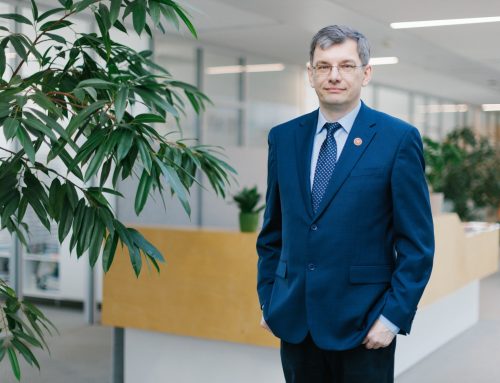
Volodymyr Turchynovskyy, Dean of the UCU Social Sciences Faculty
“Historian Timothy Snyder says: ‘As Ukraine goes, so goes the world.’ And, truly, the Russian aggression, with its genocidal motivation, demonstrates that not only does Ukraine face a threat but the whole world does, also. And if we win this war, conquering racism, all democratic countries will win with us. For this, we need to form a space of common meanings, develop a space for authentic communication, and remain within the coordinates of truth and goodness,” added Volodymyr Turchynovskyy. “We are prepared to fight, but we need the solidarity of our friends from the Western world, and conferences like this signal that the American academic community is with us in this battle. And the Ukrainian Studies Hub is a very important part of the infrastructure of forming meanings and visions for the future, for which we in Ukraine are paying an extremely high price.”

Photo by Peter Ringenberg/University of Notre Dame
Rector Taras Dobko headed the UCU delegation. In his talk at the conference, he emphasized that it is not easy to be a Ukrainian today. “Foreigners are not in a hurry to get a Ukrainian passport or even to visit Ukraine. Our enemy is trying to make Ukraine a symbol of failure and ruin. To live with hope in such a country means to carry out a mission which is to bring hope where there is pain, where everything is falling apart, and where anxiety reigns. For war-torn Ukraine, hope is not only a spiritual resource and a source of strength for people in difficult times, but also a strategic security asset,” emphasized Taras Dobko in his speech.
Oksana Markarova, Ukrainian Ambassador to the USA, also spoke at the conference. She warned that Russia is trying to delegitimize Ukraine as a state and called upon those present to continue to inform people throughout the whole world about what is at stake in this war.
“Appropriating Ukrainian culture and denying our national identity remain key areas of Russia’s criminal war against Ukraine. This puts the task of decolonizing Ukraine and the Ukrainian status in the center of our efforts. We should restore historical justice and reject any of Russia’s pretensions regarding Ukraine and our statehood,” said Oksana Markarova.
UCU President and UGCC Metropolitan of Philadelphia Borys Gudziak was one of the conference’s main speakers. He emphasized that Ukraine needs solidarity: “I hope that today Ukraine can give America hope to not be afraid. Say what is true. Witness. Make a stand for the immigrants, for the poor, for the unjustly fired. It’s easy to get crushed by fear. Today in Ukraine, there is great anxiety, but there is also trust—trust in God.”

UCU President and UGCC Metropolitan of Philadelphia Borys Gudziak. Photography by Matt Cashore
Volodymyr Turchynovskyy noted that in the Western world there is a milieu which sees and understands the situation in Ukraine, where it is obvious that Russia is the aggressor and it is Ukraine which is fighting for democracy, for freedom, for dignity, and for the renewal of the whole international order. But there is also a milieu which does not see to the end or understand this context. So, it is extremely important that there is cultural and scholarly diplomacy, which should disprove and root out false stereotypes which have entered the space of many American milieus and media.
“It is necessary to explain that we all are living in the format of a hybrid war, for the goals of which 21st-century technologies are opening up new, very powerful possibilities and instruments. So, our task at the conference was to explain that the war is not only the hundreds of kilometers of the frontline but a much wider process which has gone far beyond the boundaries of Ukraine. It seems to many that the war is far away, but, in fact, in the informational context ‘mines explode’ in our telephones and computers, and it’s necessary to learn not only how to see this but how to combat propaganda. And even if some day the source of genocidal toxicity stops existing, intoxication from the ‘Russian world’ idea will last long years. So, it is extremely important to build a global culture of humaneness, which will find an antidote and strengthen our immunity, healing our social, academic, and political space. And, it seems to me, thanks to this conference, the future activities of the Ukrainian Studies Hub, and the partnership of our universities, we will be able to become stronger and more resilient in the face of these challenges and, most importantly, we’ll be able to resolve them,” said Dr. Turchynovskyy.

It is significant that the conference was held at a time when in the USA the theme of Ukraine is being heard very loudly, above all in the context of a politically controversial discussion. “It is difficult to accept a situation when the establishment of the USA is starting to look on Ukraine as only one of the sides of the conflict, and not as a partner and ally in the battle with evil, striving to achieve a quick ceasefire along the line of confrontation,” added Volodymyr Turchynovskyy. “However, we were overwhelmed by an entirely different feeling during the conference, when we saw that our American colleagues are inspired by the battle in Ukraine, which is bravely offering the world a new perspective and hope.”
We add that the Ukrainian Studies Hub at the Nanovic Institute of the University of Notre Dame plans to organize similar conferences every two years. The hub will also prepare a series of publications about Ukraine in the English language. The Ukrainian Studies Hub will offer research grants for joint projects of the University of Notre Dame and UCU, and also internships for students and professors of both universities.