“When I returned from the war, my worldview fell apart. I did not understand how people could live and pretend that the war did not exist. I am not saying that we should put our lives on hold. No, we are obligated to live on, get an education, implement changes, and create opportunities for our children, because they are the future, and we all understand this. But we should not pretend that the war does not exist,” said Kateryna Lutsyk. Lutsyk is a veteran, a master’s student in the Public Management and Administration program at the Ukrainian Catholic University (UCU) School of Public Administration. She is also a CEO of the NGO “Defense – Association of Volunteers”, and director of the “Veteran Space” municipal institution for the Khmelnytskyi City Council.

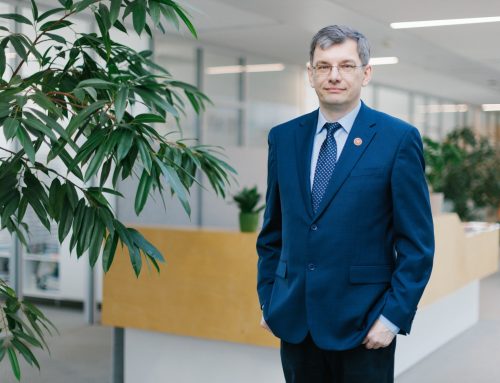
Kateryna Lutsyk
On July 7, 2015, eighteen-year-old Kateryna Lutsyk volunteered to go to the front, where, while saving others, she almost lost her own life. Over five years of deployments in the Donetsk region, she saved hundreds of lives under fire. Constantly risking her life, she was eventually wounded and forced to return to civilian life. In 2021, she resigned from the Armed Forces of Ukraine, but on February 24, 2022, war reentered her life. By the time the full-scale Russian invasion began, she had already established the operations of a large volunteer association called “Veteran Space”, in the city of Khmelnytskyi.
“My father is a military doctor. My brother is a career military man who has served in the Armed Forces of Ukraine his entire adult life. My husband is in the military, and I have many friends in the Armed Forces. When I talked to my brother and friends, I often heard that there was a catastrophic shortage of frontline medics. At the time, I was graduating from the Shepetivka Medical School [in 2015 – ed.], and I still had no definitive plan for my future. However, the catalyst that pushed me to go to the front was the death of a friend. He died from a relatively simple lung injury: a pneumothorax. With proper and timely medical assistance, he could have survived,” Kateryna says regarding her decision to volunteer.
Originally from Izyaslav in the Khmelnytskyi region, Kateryna Lutsyk is a military medic who has saved the lives of more than 200 soldiers. She decided to go to war in 2015 while still in medical school. She became a medical instructor in the 122nd Airmobile Battalion of the 81st Brigade, where she served for four years. After her rotations in the ATO (Anti-Terrorist Operation) zone, she continued her service in Zhytomyr, sharing her combat experience with other medics. She experienced severe post-traumatic stress disorder (PTSD), worked with psychologists, and underwent eye surgery. With the onset of the full-scale Russian invasion, she dedicated herself to volunteering, training medics, and helping veterans and their families. She successfully united people to create a large volunteer organization in Khmelnytskyi, Defense – Association of Volunteers, which later served as the foundation for the region’s first Veteran Space.

Kateryna is currently pursuing a master’s degree in Public Management and Administration at the Ukrainian Catholic University. At the time of this interview (January 2026 – ed.), she is simultaneously studying in the Veteran Leadership Program 2.0, run by the CHESNO Movement and the UCU School of Public Administration.
As part of the Small Stories of the Great War project, we are sharing Kateryna Lutsyk’s story—discussing the role of women in the military, rehabilitation after being wounded at the front, working with veterans, and the role of faith in war.
Q: Kateryna, tell us how the full-scale war began for you. What are your memories of that day?
Lutsyk: That day began with intense activity. Even before the full-scale war started, we discussed the fact that it was inevitable. I remember it clearly: on February 23, at about ten o’clock at night, we had a conference call with our volunteer team. We discussed training medics for the newly created Territorial Defense Forces (TRO). We were supposed to pass our experience on to new medics. We had even planned a trip to Mariupol for March 2022, where I was supposed to conduct tactical medicine training.
Our team in Khmelnytskyi had been instructing the public through online broadcasts and local TV programs on how to prepare for a major war and how to pack emergency “go-bags.” Therefore, when the full-scale invasion began, I headed straight to my office. By the time I arrived, public transportation had already stopped running, and about a hundred people were standing at the door. People were gathering because they knew this was a designated meeting point, but they didn’t know what to do next or how to act. I remember a pervasive feeling of confusion, fear, and chaos.
February 24, 2022, was incredibly active. Our team, which later grew into the NGO “Defense – Association of Volunteers”, immediately began organizing humanitarian aid, securing vehicles, and finding drivers. Our buses delivered humanitarian aid to various parts of Ukraine because, at that time, it was very difficult to determine exactly where the front line was.
Q: How did you join the Army in 2015? How did it all start?
Lutsyk: My father is a military doctor. My brother is a career military man who has served in the Armed Forces of Ukraine his entire life. My husband is in the military, and I have many friends in the Armed Forces. When the war began in 2014, I was still a student at the Shepetivka Medical School.
When I spoke to my brother and friends, I often heard about the catastrophic shortage of frontline medics. I was graduating from school at the time and had not yet made a final decision about my future. The event that forced my decision was the death of my friend. He died at the front from a relatively simple lung injury: a pneumothorax. With proper and timely medical assistance, a person can survive a long wait for evacuation. I realized he died because there was no medic nearby to provide qualified care. That was the turning point for me. I was on the verge of choosing between working in a civilian hospital—where everything is planned and there are many qualified specialists and medical staff—or going to the front.
I realized then that my skills could directly impact saving people’s lives.
Q: During your service at the front, you saved many lives—more than 200. Is there a particular story that stands out to you?
Lutsyk: Every saved life is exceptionally valuable because life is the most precious thing we have. But if we are talking about what sticks in my memory, I often share this one story:
We were on a combat mission, and a soldier suffered a complex carotid artery injury. This type of injury is considered one of the most severe because a person can lose so much blood in just a few minutes that they simply die. At that moment, by clamping the artery with our fingers, we managed to evacuate him, save his life, and transfer him to the stabilization point. And that guy is alive. By the way, he continues to serve in the military today.
I knew we had saved him. A few days passed, and I was still carrying out combat missions in our positions with the guys. My phone rang, which was surprising since it was very difficult to get cell service out there. I picked up the phone and heard a child’s voice simply say, “Thank you for saving my dad.” Those words will probably never be erased from my memory. It was such a powerful moment and the ultimate source of motivation.
Q: Do you remember your first day in the 122nd Battalion? What was the scariest or strangest thing? Was military service what you imagined it to be?
Lutsyk: My idea of military service and the reality turned out to be very different, even from the moment I prepared to leave for the Army. To give you an idea of my naivety, I called my brother to ask what I should pack—I even asked him if I could bring a hair dryer.
I arrived at the battalion headquarters in October 2015 after three months of military training in Zhytomyr. Our brigade was stationed in the Donetsk region. We arrived very late—around one or two in the morning—so everyone was already resting. There were about ten of us from the training center in Zhytomyr, and we lined up in the corridor. The battalion commander came out to introduce himself. I remember it clearly: he came out, greeted all the guys, and when he finally reached me at the very end of the line, he could not hide his shock at seeing such a young woman coming to serve.
The next morning during our 7:00 a.m. formation, I remember the others staring at me as if I were a circus monkey; no one expected to see me there.
My commander, whose call sign was “Arab,” was like a father to me. At first, he was very protective and hesitated to let me go to combat positions, but we eventually reached a mutual understanding. I was constantly on combat duty because it was absolutely necessary, and I consistently performed well.
Q: What was the attitude of your comrades?
Lutsyk: That is an interesting story. I wouldn’t say there was any overt negativity, but I could see doubt in their eyes regarding my professionalism. There was distrust: they wondered what a young woman could possibly do on a combat mission, how she could help them, and so on.
The war naturally sorted everything out during our first combat mission. Because there was no other medic available, I went with them. When we returned with our first casualties, they had seen me in action. After that, my comrades refused to go on missions without me.
Over time, their doubts faded, and we became a tightly knit unit; they often referred to me not as their sister, but as their brother.
If a newcomer joined the battalion and tried to express doubt, the veterans quickly shut it down, saying, “Just wait—soon you will be begging her to go on a mission with you.” We built an incredible brotherhood, and we maintain contact to this day. The guys often joked that, fortunately, no one ever got injured when I accompanied them, which made them feel much safer.
Q: What qualities does a person need to remain an effective medic under fire at the front?
Lutsyk: You can study the theory, but people have different psychological profiles; no one knows how they will truly respond in a real-life situation—whether they will run away, do their job, or freeze in place.
Preparation and training are absolutely crucial. Under extreme conditions, you do not have time to think; you must operate on autopilot.
That is exactly what happened to me. There were moments when we were evacuating the wounded—our task was to pull them from the line of fire and transport them to the 20-kilometer zone where doctors manned the stabilization points. More than once, I couldn’t even remember the sequence of events. It wasn’t until we were physically transferring the wounded that I began to analyze my actions and the medical algorithms I had followed. In moments of extreme danger, there is a massive adrenaline surge, and your body takes over automatically. My skills were thoroughly ingrained; the tears and the physical tremors only caught up with me later.
Regardless of your role—whether you are a rifleman or a medic—if you have received rigorous, high-quality training, it is highly probable that you will react automatically in a crisis because of sheer repetition. Consequently, the likelihood of panicking or freezing is significantly reduced.
Q: In 2016, during a combat mission, you were injured. Tell me how it happened. What did you feel at the moment of injury—were you aware of the danger, or did you simply act on instinct?
Lutsyk: I was wounded in the Avdiivka industrial zone in 2016. In addition to evacuating and stabilizing the wounded, I regularly toured the positions to help prevent seasonal illnesses.
We had been stationed at those positions for almost eight months, which is a substantial period. When soldiers live in damp dugouts and abandoned buildings for that long, the threat of common diseases rises. These rounds also boosted the guys’ morale; dropping by to joke and drink coffee helped break up the monotony.
One day, while making our rounds, our vehicle was climbing a hill when the driver said to me, “They are shooting at us.” We were driving a vehicle clearly marked with red crosses, meaning we were easily identifiable as medics from a distance. At the time, the Minsk agreements were dominating the news, though they were entirely ineffective then, just as they are now.
I didn’t hear the first shot, but the next one came from a sniper. He aimed directly at me, but because the vehicle was moving, the bullet pierced the windshield and exited through the side. I was shredded by flying glass, and my eardrum was ruptured. We immediately bailed out of the vehicle as they continued to fire, trying to pin us down. We crawled away. Later, our comrades—who were monitoring enemy radio traffic at the time—heard them say, “Wait, they will return, and then we will shoot them all.” Fortunately, we were traveling alone. As darkness fell (and lacking the modern night-vision technology we have today, making movement harder to track), the Russians fired on our vehicle again and set it ablaze. It burned to the ground.
I remember vividly that I simply could not open my eyes; the pain was excruciating. Zhenya [the driver – ed.] and I called out to one another as we crawled away. When the guys from our position finally reached us, I saw the sheer terror on their faces, though I didn’t initially understand why. It wasn’t until I looked in a mirror that I realized my face was severely lacerated and covered in blood.
I was slipping in and out of consciousness. Despite the sharp pain, I refused to be evacuated and returned to my position. My colleagues administered an IV drip, but when my condition began to deteriorate, I was finally hospitalized. I stayed in the hospital for three days.
The guys started calling me because they desperately needed medical support. Consequently, I refused further hospitalization and returned to the front. In hindsight, had I stayed in the hospital, I might have saved my hearing; today, I am completely deaf in one ear. Nevertheless, I continued to carry out my combat duties while receiving localized treatment on the spot.
A week later, our positions came under terrible shelling, resulting in many casualties. I viewed it as my personal mission to save those people; I knew I had to be there. I have no regrets, because the lives I was able to save in the immediate aftermath of my own injury made it entirely worth it.
Q: How long did you remain at your positions after the injury?
Lutsyk: About two months. Then we relocated to the PPD [permanent point of deployment – ed.]. I didn’t return to the military hospital. We completed another combat tour, and only after we rotated out did I finally address my medical treatment at a civilian hospital.
Q: Did the injury change your priorities? What did you rethink during that time?
Lutsyk: I now view my injury much like a chronic illness that many people live with—it simply requires ongoing management. My priorities changed, though not solely because of the injury; they shifted in the broader context of the war.
My life was definitively split into “before” and “after” the war. My core values fundamentally changed.
When I returned—even on leave—and listened to my civilian friends discuss their problems, their concerns seemed trivial and almost absurd to me. I completely changed my outlook on everything: my career, my environment, my entire life.
My social circle now consists of 80% military veterans and 20% civilians. Those civilians, however, are deeply engaged and share my core values. Unfortunately, much of my former civilian network has naturally been filtered out.
Q: What motivated you to pull yourself together and keep moving forward?
Lutsyk: It was a difficult process. When I finally returned, I found myself in a completely civilian city. I served in the 81st Airborne Assault Brigade, which was stationed in the Donetsk region. For us, there was no such thing as completing a combat mission and casually returning to Zhytomyr, Khmelnytskyi, or Lviv to see our families or sleep in our own beds. Even when we returned to our base, we were still stationed directly within an active combat zone.
When I returned from the front, my entire worldview collapsed. I could not comprehend how people could go about their lives pretending the war did not exist. I am not suggesting that we should put our lives on hold. On the contrary, we are obligated to live on, pursue education, implement reforms, and create opportunities for our children, because they are our future. But we absolutely must not pretend the war is not happening.
I often faced hostile glares when I wore my military uniform. I remember getting on public transportation, showing my combat veteran’s ID card, and having a healthy, draft-age man sneer and ask, “How did you earn that?” These might seem like trivial incidents to some, but they were deeply triggering for me. It was an incredibly difficult adjustment.
I returned to my small hometown, where there were no opportunities or support organizations for veterans. There was no safe place where I could go without being asked intrusive questions—and I desperately needed that.
It was a difficult period in my life, and I began to withdraw into myself. I was diagnosed with post-traumatic stress disorder (PTSD) and underwent treatment with a psychotherapist. As I started to recover, I began thinking about returning to work—at the very least, to support myself and keep living.
However, after everything I had experienced, I realized I did not want to return to medicine. But where could I go? To a civilian team completely disconnected from the war? That felt too difficult; I simply wasn’t ready. This is where my circle of brothers and sisters-in-arms played a crucial role.
My sister-in-arms, Maria Berlinska [a servicewoman, public figure, and volunteer – ed.], whom I met at the front, became a reliable pillar of support. Together with Lyuba Shypovych [a public figure, volunteer, and founder/head of the Dignitas charity foundation – ed.], she helped me adapt and started involving me in a non-governmental organization (NGO) working with veterans. I was among my own people, in an environment that felt comfortable and calm.
Slowly, I began to return to life. We worked on many different projects. I served as an ambassador for the Veteran Diplomacy Club, which Maria Berlinska founded. We visited numerous cities in Ukraine and across roughly 20 countries worldwide, speaking at diaspora and volunteer organizations, institutes, the UN headquarters, and the US Senate.
In these speeches, we advocated for the film The Invisible Battalion [a Ukrainian documentary anthology about the participation of Ukrainian women in the war with Russia, featuring six stories told by three female directors to show the reality of the war – ed.]. We used these personal stories to garner global support. After all, at that time, the international community did not fully recognize that we were at war and under attack, and we wanted to advocate for that reality. Furthermore, we wanted to highlight the role of women in the Armed Forces of Ukraine, which was still considered a curiosity at the time.
This deep involvement in NGO projects and the public sector made my transition back to civilian life much easier. The principle of peer-to-peer support truly works. In fact, we were right in the middle of our Invisible Battalion advocacy mission when the full-scale invasion began.
On March 17, 2022, we registered our NGO, “Defense – Association of Volunteers” [the association currently collects humanitarian aid for servicemembers, displaced persons, and residents of regions affected by hostilities – ed.]. We soon underwent a transformation, as we began receiving numerous requests from military families who had lost contact with their loved ones, asking for help finding information, locating documents, or getting news about the deceased. We realized we needed to create a dedicated veteran space, primarily as a direct response to these urgent challenges.
It was my dream as a veteran to create a safe place where veterans and their families could go—a place where they would feel like they were among their own, where they could talk, find opportunities, and discover support and resilience. That is exactly why we launched the Veteran Space of the Khmelnytskyi City Council on the foundation of our NGO, with the help of international partners and local businesses.
We formed a multidisciplinary team of case managers and specialized experts, and we began working with the families of military personnel while their loved ones were still in service. These families are our primary stakeholders and our key entry point. When a servicemember returns, it is much easier for us to engage with them if we already have a relationship with their family. Today, we work with all target audiences: active military personnel and veterans, their families, and the families of the deceased, missing persons, and prisoners of war.
We operated as an NGO for a year before transforming into a municipal institution of the Khmelnytskyi City Council, working in cooperation with the mayor of Khmelnytskyi, Oleksandr Serhiyovych Symchyshyn. Ultimately, a facility like this belongs within the city council’s structure so it can serve as the primary “entry point” for veterans. This ensures sustainability, especially since many veterans and their families instinctively go directly to the city council with their requests.
This led to the official creation of the Veteran Space of the Khmelnytskyi City Council, where I currently serve as a CEO. We operate in a hybrid format: we have maintained our NGO, so our work is funded partly by grants and partly by the local municipal budget. I sincerely believe that we will succeed and eventually establish a dedicated veteran policy department within our community.
Veteran policy is an area that will continue to develop and remain highly relevant, especially after the war. Therefore, my role now is to build a comprehensive support system for veterans and their families.
At the level of the Khmelnytskyi territorial community, this is deeply important to me—both because of my personal experience and because of our collective responsibility. After all, veterans leave their communities to join the military, and they return to those same communities. It is the community’s responsibility to create the necessary conditions and opportunities for them. My mission has now shifted from serving in the Armed Forces of Ukraine to serving the veteran community.
Q: What do veterans need most right now?
Lutsyk: Currently, 80% of our applications come from the families of military personnel, as the majority of our future veterans are still on active duty. Those who have been discharged are mostly dealing with complex injuries, and during their first year at home, their primary need is physical rehabilitation. They may not come to us for general services right away, but they do turn to us for help with registering for disability status, applying for benefits, arranging transportation, or securing physical rehabilitation equipment.
Their most urgent priority is restoring their physical health. Only after that do they move on to other stages of recovery. Beyond physical needs, the most common requests are for legal and psychological support.
On one hand, this highlights the immense collective trauma we are facing. On the other hand, I am personally pleased to see that we have overcome a major cultural barrier: people are now willing to see a psychologist and admit they need help. The sooner we recognize this need and begin doing the work, the less severe the long-term consequences will be.
Another major need for veterans is employment. However, this request often comes with a caveat, because many veterans—like me—do not want to return to their previous places of employment.
Some simply cannot go back to their old jobs, while others actively want to retrain for something new. This requires a highly individualized approach. For some, we find new corporate vacancies with decent pay, flexible schedules, and customized working conditions. For others, the goal is opening their own business or getting involved in community activities. We help them establish NGOs, write grant proposals, connect with potential partners, and more. There is no one-size-fits-all statistic for what veterans need.
Our work with a veteran doesn’t end once they are employed or enrolled in an educational program. We try hard “not to lose” the veteran: we integrate them into various support groups and peer networks where they can communicate with people who share their experiences, grab a cup of coffee, or attend workshops. We organize retreats where they can go fishing while also working with a psychologist. In short, we strive to meet their basic needs while providing additional opportunities for restoration, fulfillment, and the search for new resources and meaning.
Q: You mentioned women veterans. How has the attitude toward female veterans changed during the full-scale war?
Lutsyk: As of today, there are approximately 70,000 women serving in the Armed Forces of Ukraine, with about 10,000 in the broader Defense Forces directly performing combat missions.
Unfortunately, many women have already died, and this reality needs to be discussed and covered. I am not asking for special attention. Only very recently did we officially adopt the feminine term for “defender,” even though women have been carrying out combat missions on an equal footing with men all along.
I believe that if you have the desire, meet the requirements, and possess professional physical training, there should be no gender division. We must show this and cover it because it is our reality: women fight alongside men, executing missions together.
Q: You are currently studying in the master’s program at UCU while simultaneously participating in the program for veterans. What motivated you to enroll, and why did you choose UCU?
Lutsyk: It is a coincidence that I am enrolled in both programs simultaneously. I did not initially know that the veterans’ program would be held at UCU. As I mentioned, we established a municipal institution and began developing veteran policies within the community. At a certain point, I realized I lacked the necessary experience and knowledge, which is why I decided to pursue further education.
To be honest, I applied to two universities and was accepted into both. The other university offered me a 100% scholarship, which meant it would have been financially advantageous for me to go there. However, I chose UCU. First and foremost, I chose it for its value framework. Not many universities are so human-centric and place such a strong emphasis on values; here, the focus is on dignity, honesty, and service. That is deeply important to me. The presence of faith is also significant—it is not obtrusive, but rather seamlessly integrated into the educational experience. As a veteran, I can say that for me, faith is not about a specific religion; it is about internal support. This was a major factor in choosing UCU. Equally important is the community, as it matters to me who surrounds me. I want to be around people who share my worldview and values. Let’s be honest, I don’t know many universities guided by these principles. Considering all these aspects, UCU was the best option.
Regarding the veterans’ program: veterans belong in politics. However, they need to understand how politics works, who to work with, and what they are fighting for. From the beginning of the war in 2014 to the elections in 2019, where were the veterans? They were not given the opportunity to change anything. It isn’t even clear if they actually received their promised privileges. That is why I enrolled in the veteran leadership program. I want to understand this field and gain the necessary experience and expertise. When I found out the training would be held at UCU, I was pleasantly surprised.
Q: What does support mean to you as a veteran today?
Lutsyk: People. I always tell my team that I love people and am inspired by them.
I am also supported and inspired by my family: my dad, my husband, and my battalion commander. He knows how to give directions, offer support, and provide suggestions based on his management experience. My team is another pillar of support; they simply do not let me give up. The people around me—veterans, their families, and those who care—are incredibly important.
At the Veteran Space, we work with many guys who have returned from Russian captivity. For example, we employed one such veteran, and he is now one of the best employees in my organization. Realizing that I played a part in that inspires me more than anything.
Q: What do we need to do to win this war? What should a renewed Ukraine look like?
Lutsyk: We must not be indifferent. We must be effective, with everyone taking responsibility in their own place. We need to help those who are fighting—not just with words, social media posts, or likes, but with concrete actions.
Those at the front must feel and clearly understand that we are truly their rear guard. It isn’t just about words; it is about building opportunities, preparing the ground for their return, taking care of their families, creating support programs, and actively helping the military. When they realize we are doing this, our collective responsibility will truly become effective.
Let’s be honest: our main battle will begin after the victory. When everyone returns home, we will face numerous challenges and high social tension, and we must prepare for that now. It is terrifying to even imagine the final number of the dead and missing. This is the most terrible price imaginable. However, there is a psychological concept known as “post-traumatic growth.” I sincerely believe that this transformational period will be a turning point for everyone and will result in that kind of growth. Many people will return ready to take responsibility and wanting to live differently. We absolutely will not tolerate paternalism, the idea of being a “fraternal people” [with Russia], or any of those old narratives—they simply will not work anymore.
We must take responsibility right here and now, because we cannot predict what will happen later. The future depends entirely on what we do today. We must realize this and let it guide us every single day.
When I envision the Ukraine of the future, I see a nation that is humane, strong, honest, and people-centered, backed by a powerful military. We must prepare. We need a strong army and an open society whose values have fundamentally changed—a society that has drawn conclusions and radically shifted its paradigm of thinking. We are currently in the midst of this process, evolving as both a society and a nation.
Q: What is your recipe for ensuring that society does not “lose its memory” once the war ends?
Lutsyk: We must start forming the memory of the price of our freedom right now. When we talk about memory, it is essential to cultivate a culture of respect, honor, and heroism. We must subconsciously instill this memory and respect within ourselves.
When we see a soldier approaching, we should place our hands over our hearts. When we know there is a national minute of silence at 9:00 a.m., we shouldn’t be walking down the street carrying cardboard boxes. I say this because it happens in Khmelnytskyi. The situation is better now, but a year ago, people wouldn’t even stop in the streets. When I stop my car in the middle of the road for the minute of silence, people behind me start honking… It comes down to everyone’s shared responsibility. What are we doing now?
We must start with ourselves, teaching these basic principles to ourselves, our children, and our families first and foremost. Naturally, this should also be regulated by a national framework—through memorial events and a formalized policy of memory. We must remember the price of our independence. We shouldn’t adopt a victim mentality, but we must never forget. If a generation or two passes and we start being friends with Russia again, saying, “What difference does it make?”, then our grandchildren will be forced to fight this exact same war.
Q: What is the role of faith in this war for you?
Lutsyk: For me, having faith at the front is about internal support. I know of many cases where people who called themselves atheists began to believe. And this doesn’t just happen at the front, but also upon their return. When you cannot find external support, faith keeps you going and provides that inner strength.
I was very fortunate that on one of my combat missions in Avdiivka, Father Andriy Zelinsky [a UGCC priest, military chaplain, and UCU instructor – ed.] was with us. He was constantly present, and we had the opportunity to communicate. He profoundly changed my views on faith and my overall attitude toward religion.
I do not believe in coincidences. It was probably meant to be that Father Andriy was with us. As it turned out, he was there when I was injured, and he was there again when I returned and faced certain difficulties. Not everyone wants or is ready to talk about these things, but the front is a place where it is extremely difficult to survive without faith.