In our time, it’s important that each person understands how to find hope and ways to heal the wounds of war, because, in one way or another, every Ukrainian is traumatized: Some have visible scars on their bodies or amputations, and others have deeply concealed spiritual wounds. So the book of Dr. Richard F. Mollica, “Healing Invisible Wounds: Paths to Hope and Recovery in a Violent World,” a translation of which was recently published by the Ukrainian Catholic University Press, is truly necessary for us.

Presentation of the book of Dr. Richard F. Mollica, “Healing Invisible Wounds: Paths to Hope and Recovery in a Violent World.”
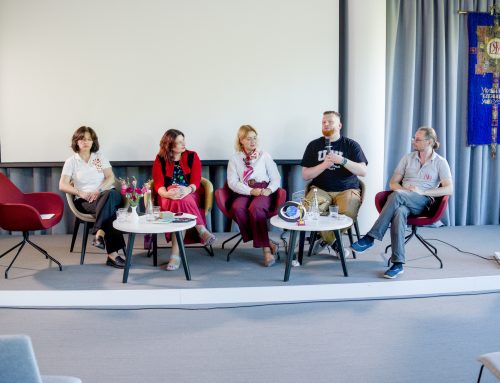
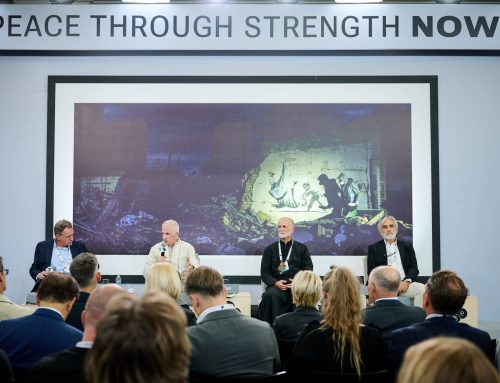
On September 4, as part of UCU Days, the book was presented in the university’s main academic building on Svientsitskoho Street.
Dr. Richard F. Mollica is a psychiatrist who has worked with people who’ve suffered trauma in various countries, from Cambodia to Bosnia, from Rwanda to New York after 9/11. He’s the founder of the Harvard Program in Refugee Trauma. In his book, Dr. Mollica has recorded his personal experience, shared stories from his own practice, and also gives advice on how to help people in pain. “Healing Invisible Wounds” involves deep research on the influence of traumatic experience on personalities and society, and is also a practical textbook on overcoming the effects of violence.
“This books helps us understand that we Ukrainians are not experiencing something unique, that wars are always brutal and violent. But we can draw strength from the stories of people who have gone through their own hell and conquered it,” explained the head of UCU Online, Roksoliana Voronovska, who moderated the presentation.

Roksoliana Voronovska
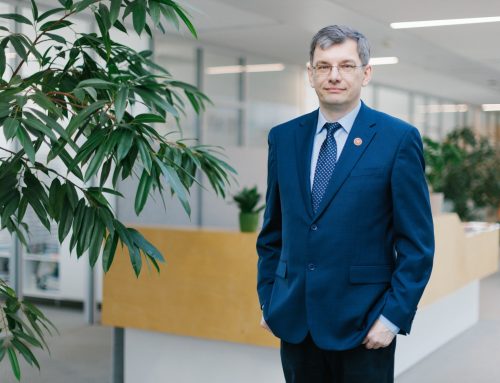
Archbishop Borys Gudziak, Metropolitan of the UGCC Archeparchy of Philadelphia (USA) and President of Ukrainian Catholic University, thanked all who worked on the book.

Metropolitan Borys Gudziak
Reflecting on how we can help people who have suffered traumatic experiences, the metropolitan stated: “We will help if we are part of the solution and not the problem. So it’s very important to take care of yourself, your spiritual health and physical condition. Helping people who have suffered trauma means, first of all, seeing it. Though many traumas are visible – amputations, scars – some are not visible, because it’s almost impossible to live through a war for 11 years and not to have some marks from it. I think that this book has much to teach. But first of all, it’s necessary to understand that we ourselves need to be in good form, to be open, sensitive, the kind of people who gain the trust of others, in order to help people who have suffered trauma.”
Oleh Romanchuk, a doctor and psychotherapist, children’s psychologist, and director of UCU’s Institute of Mental Health, stated that the book’s main message is self-healing.

Oleh Romanchuk
“The author wanted to say that we have the strength with which we can heal difficult experiences, and this strength is in us and among us. I think that for Ukraine this is a great message of hope. International experts are predicting that everyone in our country will be wounded. But this book says that this depends on us, because we have the choice to trust the strength within us or to fall into despair. Research demonstrates that a great number of people with disorders will be healed: some without expert help, some with expert help. And, in addition to this, they can become stronger, that is, post-traumatic growth can happen,” explained Oleh Romanchuk.
He emphasized that Dr. Richard F. Mollica’s book is not simply about trauma but about violence, brutal violence which human beings commit. Reading it, you see that the most terrible things happen when a human being loses his or her humanity. And, for all whom darkness has touched, first of all light is necessary. And the book’s cover confirms this; it depicts light which is seen amid darkness.

The book of Dr. Richard F. Mollica, “Healing Invisible Wounds: Paths to Hope and Recovery in a Violent World.”
Svitlana Kohut, dean of the UCU Health Sciences Faculty, added that people are very important on the road to overcoming trauma.
“A community of healing is a community where you are heard and supported. It’s very good that we’re using the experience of other countries to heal trauma, as written in this book,” stated Svitlana Kohut.

Svitlana Kohut
This work of Dr. Richard F. Mollica will be interesting not only for experts and students but for a wide circle of readers.
The translation of the book was begun at the initiative of the late Maria (Wawa) Baczynskyj, a volunteer-teacher at the UCU Social Pedagogy Department, and completed and published after her death, during Russia’s brutal war with Ukraine.
“Wawa was a healer: She wanted to spread a life of healing and approaches for healing. The publication of the Ukrainian translation of this book is a worthy memorial to her and her life’s mission. And she’ll continue to heal, though ‘from a distance’ through eternity, these traumas which she didn’t see with her own eyes. In life, Wawa prayed for many. In eternity, this accompaniment, with a view to the company in which Wawa is present, not only continues but gains a divine dimension,” stated Metropolitan Borys in his preface to the publication.
The book was published with the support of the Press, Education, and Culture Section of the U.S. Embassy in Ukraine.