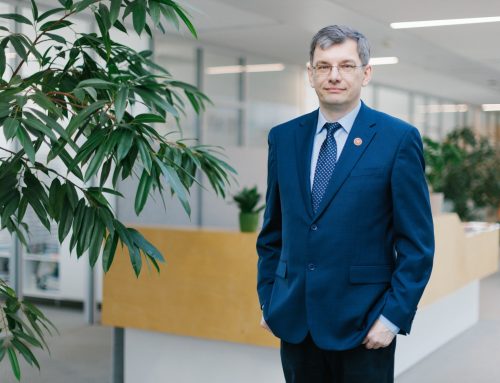
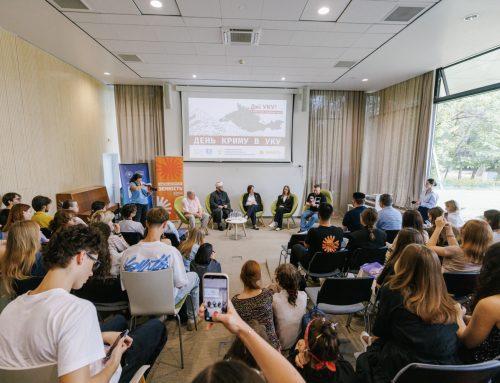
On the occasion of Ukraine’s Independence Day, the Nanovic Institute for European Studies shares below the reflections of Taras Dobko, rector of Ukrainian Catholic University, about the 2025 Ukrainian Studies Conference at Notre Dame. On this day, the institute remembers its friends in Ukraine and the work we are doing together.
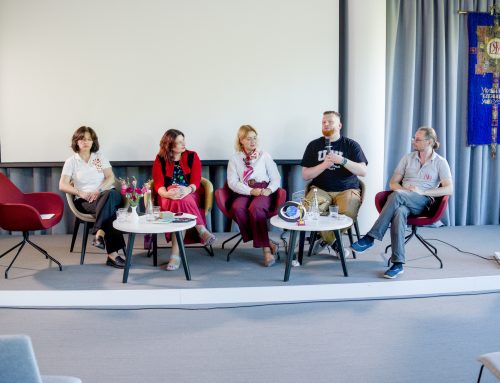
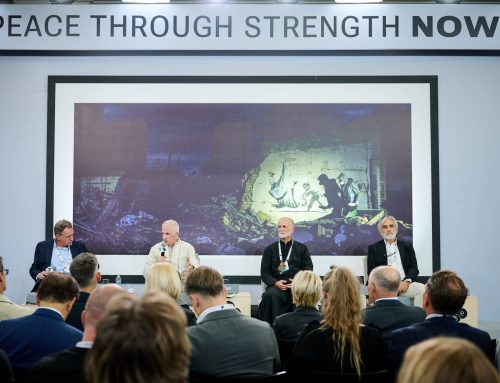
The March 2025 conference “Revolutions of Hope: Resilience and Recovery in Ukraine” was a fascinating and beautiful experience. It officially inaugurated the Ukrainian Studies Hub at the Nanovic Institute for European Studies, and so it was, fittingly, an invaluable academic exchange of ideas. However, it was also filled with artistic celebration, making friends, and praying together.
Our conference brought a lot of hope to rely on and to act on. Let me offer a linguistic observation from the Ukrainian language. The equivalent of the English word “reliable” in Ukrainian is “надійний,” related to the word “надія” (“hope”), which itself includes the term “дія” (“action”). Thus, the very language of Ukraine teaches us that we can rely on hope and act on its promises.
We had so many signs and testimonies of hope during this conference.
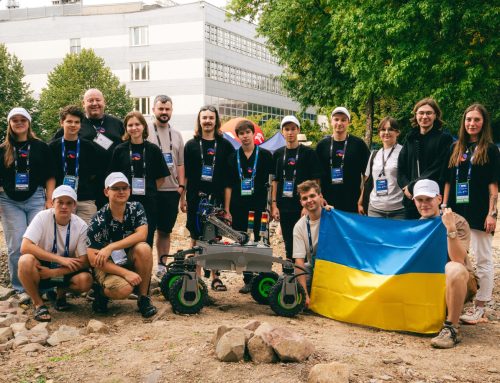
Many of these sessions reminded me of my lived experience in Ukraine. In Lviv, at least three art galleries have opened during the past few years. Likewise, it has been difficult to get a ticket for a theatre performance during the war because they are sold out. New bookstores are being opened because the book industry is thriving. These are just a few signs of hope I see.
During this conference, we also heard that we need a politics of hope, which is essentially politics based on Catholic Social Teaching and grounded in Christian values. It is my conviction that in the present adverse circumstances, Ukrainians of different social status, ethnic origin, and religious allegiance manage to survive and even look beyond survival for development only to the extent that they intuitively adhere to the CST principles of dignity, solidarity, subsidiarity (agency), and common good.
Ukrainian youth perceive freedom, justice, and dignity as inseparably connected with their human flourishing.
I am also very concerned about Ukrainians adopting a victim-based identity as a result of accepting an unjust peace deal. Regrettably, many people may already feel betrayed, but I think a politics of hope can be an antidote against this development. It is the opposite of a politics of grievances.
We witnessed this politics of hope in action in late July when young Ukrainians in many cities rallied in defense of the independence of key anti-corruption agencies and with the requirement to follow due procedures in passing resolutions which could affect the ascension of Ukraine to the EU. These events demonstrated that the democratic spirit in the youngest generation is strong and alive, and that they are ready to defend democracy both from external aggressors and “home-made” autocrats. Ukrainian youth perceive freedom, justice, and dignity as inseparably connected with their human flourishing.
This conference will have an ongoing legacy. There is already a program that accepts proposals for joint faculty research projects between Notre Dame and UCU faculty members with the potential to achieve international recognition and generate sustainable research outcomes.
This research will have much to teach us about what makes democracies resilient and how religion can play a role. For Ukraine, this is most timely. As we work toward a hopeful future, we must also plan for how to address individual and collective trauma and how to achieve physical, moral, and religious healing. The Ukrainian Studies Hub and the partnership between Notre Dame and Ukrainian Catholic University will demonstrate that the Ukrainian experience is an essential voice and example for addressing these same issues globally.
We are generating a model for Ukrainian studies. As we continue supporting individual Ukrainian scholars displaced by war, we are also cultivating academic collaboration to design a joint, long-term research program with a world-class profile and potential. I am grateful to Notre Dame for joining us in crafting this example, which will be invaluable for the future of Ukrainian academia and Ukrainian studies worldwide.
Source: Nanovic Institute