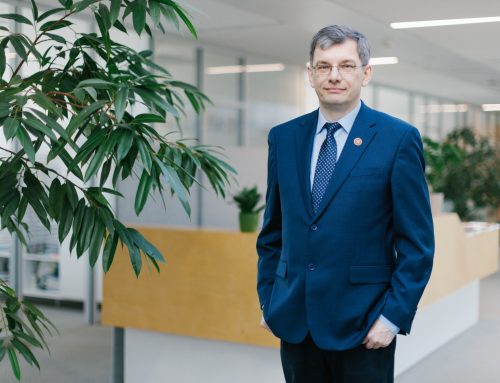
Taras Dobko on the specifics of education at Ukrainian Catholic University, grants, scholarships, tuition fees, and state-funded places.
LIGA.net spoke with UCU Rector Taras Dobko about the teaching approaches used at the university, financial aid for students, state grants, and the quality of education. They also discussed the dormitory accommodation scandal that arose in the summer of 2025.
Quality of education and competition for talent
– What is currently the biggest problem facing Ukrainian universities?
– Most problems are determined by the context of the full-scale invasion.
There is the challenge of preserving the quality of education and research. In wartime conditions, this is not easy.
To begin with, many children—especially from frontline regions—had a lot of online schooling while studying at school. Distance learning cannot fully replace in-person education, and this affects quality.
The quality of the educational process at a university depends not only on whether the lecturer is good, but also on the quality and motivation of the students themselves—on whether they know how and are ready to study. With online learning, these skills are lost.
Educational losses appear because of problems at the school level.
Another major wartime challenge is the outflow of talent, what is called “brain drain.”
Universities can play an important role in retaining talent if, even during the war, they devote sufficient attention to educational quality. In wartime there is always a temptation to relax standards somewhere.
But we must not. Because we—Ukrainian universities—are now competing not so much with one another as with foreign universities for talent. At a minimum, quality must be preserved so that young people feel that even while staying in Ukraine, they can be part of the global world and participate in projects that meet international standards.
Obviously, there is a lack of resources. This is a result of the state being forced to direct almost all the taxes it collects to defense. This leads to universities having to become more self-reliant.
– Does UCU feel a decline in the quality of applicants?
– We see certain changes.
There are two sides to this coin. On the one hand, children have become more mature and know more clearly what they want.
The lack of career guidance at the school level has always been a challenge for the Ukrainian educational system. But the war and crisis conditions forced parents and children to make choices.
We see this even in the fact that among those who entered bachelor’s programs, 83% chose our university as their first priority. That is, they knew where and why they were going.
On the other hand, there is a lack of social skills and interaction. But we turn this deficit into a positive by creating many opportunities for students for social service and volunteering.
The latest survey of graduates showed that 86% of our bachelor’s students engage in volunteer activities during their studies.
– How does UCU compensate for the losses you mentioned?
– UCU has a unique program called the “Worldview Core.” It also serves as a way to compensate for those losses. All bachelor’s students must complete it, regardless of their program.
It has three blocks: “God and Me,” “People and Me,” and “World and Me.” Within these blocks, students choose courses themselves from those offered by the university. They select what interests them and where they may lack knowledge, even compensating for what they did not receive at school. [For example, within “God and Me” there are courses such as “The Idea of God in European Philosophy,” “Church and Politics,” “Addictions and Society”; within “People and Me” – “Effective Communication,” “Development of Leadership Character,” “Humor as Social Glue”; within “World and Me” – “The Human Being in the World of Technology,” “Active Citizenship,” etc. – Ed.]
We guide students’ trajectories within the “Worldview Core,” but we give them freedom, and freedom always increases motivation.
We have managed to create a system in which technical, scientific, social, and humanities disciplines interact and complement each other.
We explain to IT students that the humanities help them understand who a person is and what society’s needs are. And IT is the tool to solve these problems and answer the questions that arise in society.
You must understand the complex world around you, how it functions, and where its gaps are, not just to code, but to formulate a problem and solve it using IT tools.
Principles of learning
– UCU graduates told me that the university creates a kind of “ideal world with the right values.” When graduates enter the real world and start working, some may experience dissonance or even shock.
– We had cases when graduates of the School of Journalism and Communication, during Yanukovych’s time, seeing “jeansa” (paid-for propaganda content), refused to work. Because it did not correspond to their principles. If that is what shocked them, I am happy about it. It means we did our job well.
The real problem is when a person suddenly finds themselves in a world they do not know, do not understand, and have no tools to respond to.
To prevent this, UCU programs are built on the principle of project-based learning. People learn not only from books, but by implementing concrete projects.
For example, cultural studies students implement projects for museums. They help create exhibitions or take part in organizing cultural events. In this way, even during their studies they understand the real needs of the sector in which they will work.
In addition, part of this project-based learning is so-called service learning—that is, when the projects students implement as part of their studies have a clear social impact. This is very important, especially during crisis and war.
There is research showing that young people who have experience in volunteering and social projects are less inclined to leave the country. When they immerse themselves in people’s lives and do something that improves those lives, they feel their significance and agency.
They feel that they are subjects who can do something, that much depends on them, and that they are doing something meaningful. This gives them a sense of inner dignity.
Essentially, this is the formation of leaders who have principles, skills, and the desire to change the world around them.
– The university is not growing very fast in terms of enrollment. Why?
– We are not planning to grow quantitatively. One of the principles of our strategy is growth accompanied by quality. We understand that rapid numerical growth can harm quality.
According to our plans, by 2030 we want to be a university with 3,000 students in all degree programs—master’s, doctoral, and postgraduate. Now we have 2,500. This means that in four years we can open at most one more bachelor’s and two master’s programs. We are not in a hurry; we will see what happens next. We also understand that the number of students affects our ability to preserve the identity we value.
That identity is personal attention to almost every student.
Grants, budget, donors
– Why does UCU not have state-funded places for students?
– This was a deliberate decision on our part, based on the following logic. For each state-funded place, the university receives from the state 20,000–40,000 hryvnias per year (possibly slightly outdated information).
Tuition at UCU for bachelor’s programs in 2025 was 147,000 hryvnias. The cost of education is $4,200 per year [almost 180,000 hryvnias – Ed.].
When a student receives a state-funded place, we no longer have the right to request any additional tuition payment. So if someone comes to UCU in a state-funded place, it means UCU is shooting itself in the foot financially.
We put ourselves at risk. That is one thing. But the second thing to note is that state-funded places go to those with the highest rankings [based on standardized test scores – Ed.]. Experience shows that the highest-ranked students usually come from families with better educational conditions and financial means.
So, as a rule, state-funded places go to people who might not even need them. The question for us is: Whom are we helping with a state-funded place at UCU? It turns out we are not helping those who cannot afford to pay.
– Do UCU students receive state grants?
– We are strong supporters of state grants and even helped develop this concept.
It has many advantages. It helps children who once could only dream of a certain specialty or university with high competition. They could not get in and could not pay. Now part, though small, of their tuition is covered by a state grant.
[State grants are awarded to students enrolled on a contract basis; the grant covers part of tuition and is provided for the entire period of study – Ed.]
This year, over 90% of entrants received a state grant.
– Does UCU have its own grants that cover 100% of tuition?
– We have scholarships that cover 100% of tuition.
During the admissions process, applicants submit applications for financial aid. In 2025, 47% of bachelor’s entrants received financial assistance—more than 480 people.
A scholarship can cover from 25% to 100% of tuition.
Overall, across the entire university (bachelor’s and master’s programs), nearly half of students receive some form of financial aid. It is provided thanks to the generosity of donors.
I want to thank donors, especially Ukrainian ones. During the war years, the amount donated by Ukrainian benefactors for UCU student scholarships has doubled.
I consider that fantastic.
– Can you give absolute figures?
– Yes. I am talking about scholarship founders in Ukraine.
For example, in 2022–2023, at the beginning of the full-scale war, we had 122 donors from Ukraine who provided a total of $405,000 for scholarship programs.
For the 2025–2026 academic year, we have 158 donors who provided $750,000. In addition, there is $110,000 from our “DoNation” program [a scholarship fund that anyone can join by setting up a monthly subscription for any amount – Ed.].
“DoNation” is a project to involve small donors and alumni in giving. Our graduates have not yet earned millions or billions, but they can contribute through small donations. It is natural for them, because many of them once received help and can now give back.
In 2025, we attracted more than a thousand such small donors.
– What share of UCU’s budget is covered by donors?
– About 50% of the operating budget, which amounts to 520 million hryvnias, or about $12 million.
Donors include individuals, charitable foundations, and organizations. One-third are from North America, one-third from Europe, and the rest from Ukraine.
Among Ukrainian donors, some support scholarships, while others contribute to faculty development, support research, invest in new programs, or become partners in creating internship and practice opportunities for students.
Major donors and win-win partnerships
– Who are the largest donors from Ukraine?
– Among the major benefactors supporting the university are the Zagoriy family foundation (founders of Darnytsia), the Believe in Yourself foundation of the Ivanchyk family (Astarta), SoftServe, and the Klymov family from Nova Poshta.
In these partnerships, the university also gives back. For example, with SoftServe and other IT companies, cooperation led to the creation of the Faculty of Applied Sciences. UCU graduates, becoming specialists, filled their R&D departments and helped transform them from outsourcing service companies into product companies.
This reflects the mindset we instill at this faculty: to become people who create products—not just coders, but those who can create new things.
They then have the knowledge, ambitions, and desire to create something new in these companies. This is a win-win situation for both us and the companies we work with.
– In 2025, there was a scandal on social media that a student was allegedly denied a place in the UCU dormitory because of Instagram photos related to LGBT topics. What impact did this have?
– A working group is now carefully reviewing both the selection criteria for the Collegium and communication in general. [At UCU, the dormitory is called the Collegium – Ed.]
They are also reviewing how they communicate what the Formational Program in the Collegium is. [The Formational Program in the Collegium is part of education at UCU – Ed.]
It is very important for us that an applicant who wants to live there understands that the primary goal is not to get a room, but to join the Formational Program and be ready to contribute to it.
We are working to make the selection process clearer and more transparent, and for decisions to be made more collegially.
– What does the Formational Program mean?
– Our dormitories function not simply as places where students come to spend the night, but as places where a community is built that can act as a community, and where students’ spiritual and leadership formation takes place.
Students live there for one or two years, and each has their own program.
The first year is a program created by the university: meetings with interesting people, volunteer projects.
In the second year, students must design their own program.
So no one simply lives in the dormitory. Students must be active participants in teams and volunteer initiatives.
Source: LIGA.net