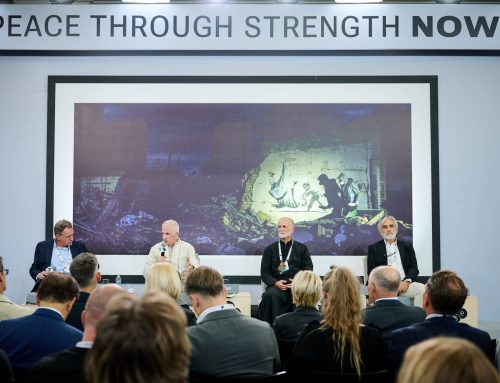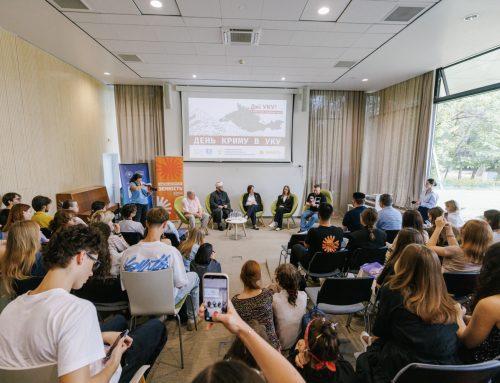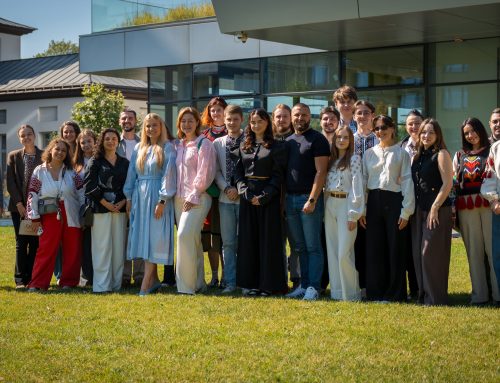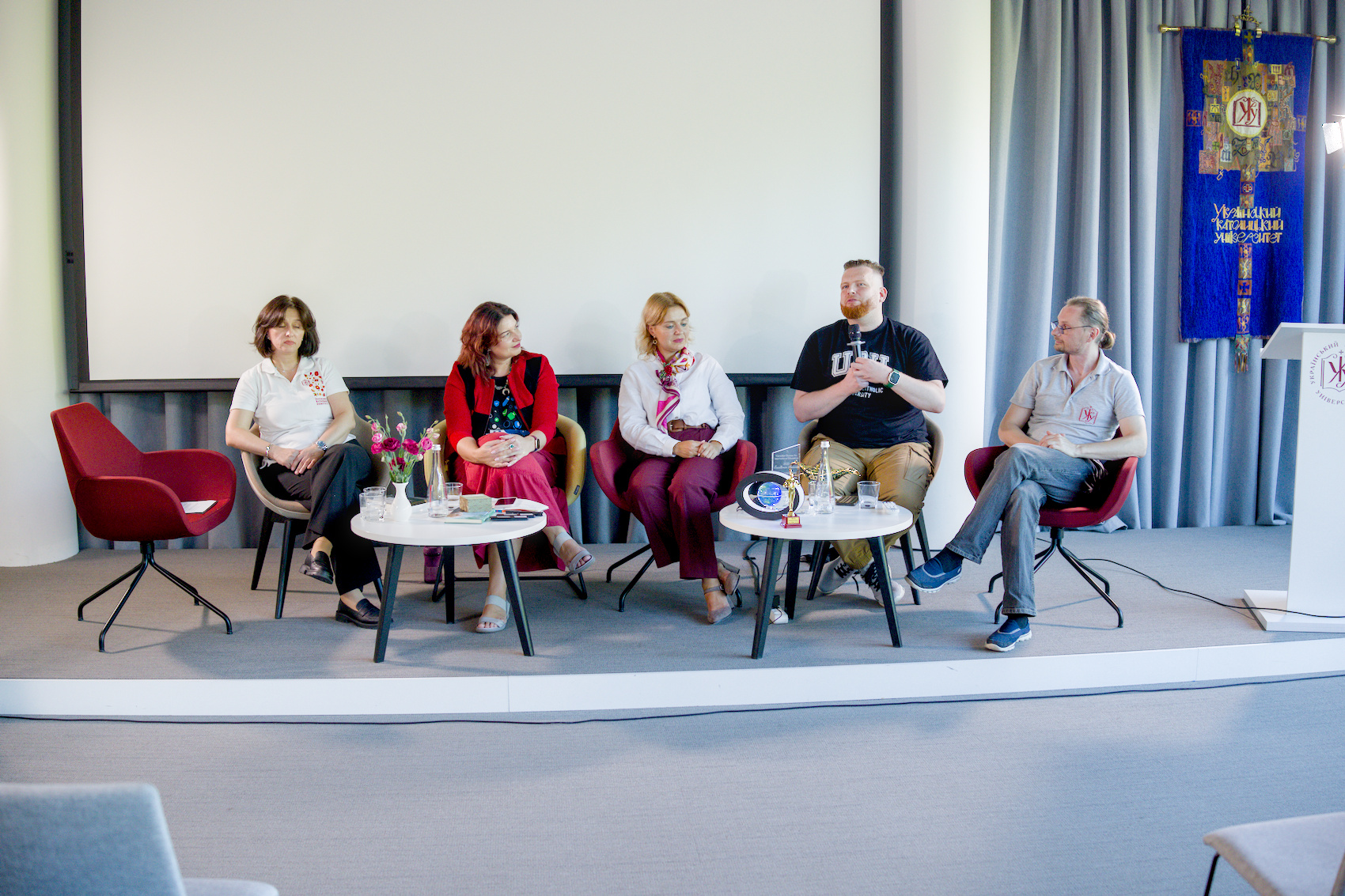
As part of UCU Days, the Ukrainian Catholic University hosted a panel discussion titled, “How My Teaching ‘I’ Sounds in the All-Encompassing ‘We.'” The event centered on the pedagogy of relationships—an approach to learning that focuses not only on knowledge and academic competencies but also on the individual, their dignity, experiences, vocations, and relationships with others.
Panel Discussion on the Pedagogy of Relationships- How My Teaching ‘I’ Sounds in the All-Encompassing ‘We’
The discussion featured fellows of the Metropolitan Gudziak Endowed Faculty Fund, including UCU Professors Roman Nazarenko, Orysia Bila, Oleksandr Avramchuk, Maria Tytarenko, and Halyna Procyk.
Participants discussed how a professor can connect closely with students while maintaining high expectations, how to create a space of trust and security, and why a personal example often teaches better than any specific method. This conversation contributed to the ongoing development of the relationship pedagogy community at UCU.
Professor of Philosophy Orysia Bila, PhD explored pedagogy through the metaphor of a spring, echoing Archbishop Borys’s belief that education should lead to wisdom, not just to knowledge and competencies. The visual symbol for her presentation was a 500-hryvnia banknote featuring Hryhoriy Skovoroda alongside a fountain. This image serves as a reminder of the wisdom, knowledge, and experience a person first receives and then passes on to others.
“As vessels, we collect as much as we can, and then we share with others when we ourselves are sufficiently filled,” shared Bila, a leading lecturer and researcher at UCU. “There is no need to worry whether your vessel is smaller or larger than others. We cannot share what we do not have. The source of our strength for each day, and what allows us to give to others, is the person of Christ himself.”
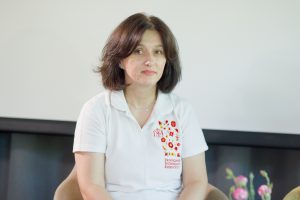
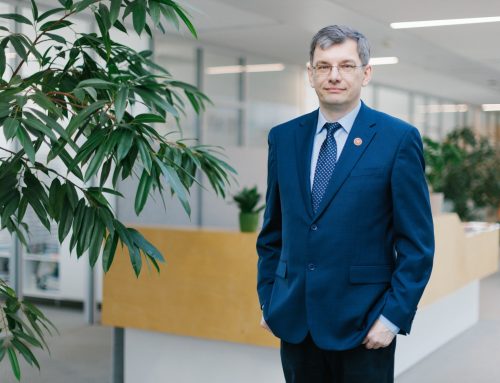
Orysia Bila, PhD, Head of the Department of Philosophy at the Faculty of Philosophy and Theology, UCU
She also recalled a personal story involving Metropolitan Borys Gudziak. In 2007, he asked her to help with a course titled “Christian Spirituality in the Postmodern Age.” When Bila mentioned she lacked the necessary literature to prepare, Archbishop Borys purchased a large selection of books on postmodernism for her. She still keeps them and lends them to students, viewing this gesture as a prime example of relationship pedagogy—when a professor imparts not only knowledge but also trust, support, and a willingness to help.
Roman Nazarenko, PhD, Director of the Institute of Religion and Society, shared how a personal experience changed his approach to teaching. After a serious car accident, he had to learn to walk again, yet he passionately longed to return to the classroom. Later, UCU’s First Vice-Rector, Yaroslav Prytula, assigned him to teach a course titled “Christianity for IT Specialists.” One of the topics covered the Gospel story of the healing of a man who had been lying near the pool of Bethesda for 38 years. Nazarenko experienced Jesus’s words—”Get up, take up your bed and walk”—as a personal revelation. He saw in this story the experience of someone who could otherwise remain trapped in their injuries and failures for years.
“Do not be afraid of your failures; do not be afraid to bring them to society and bear witness to them,” said Nazarenko. “When we work on our weaknesses, they can become our strengths.”
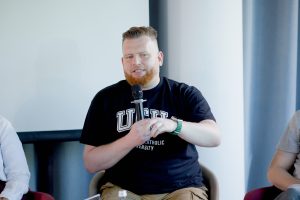
Roman Nazarenko, PhD, Director of the Institute of Religion and Society at the Ukrainian Catholic University and Lecturer at the Kyiv-Mohyla Business School
He applies this experience to his teaching, believing that the pedagogy of relationships begins with a personal example: a professor cannot help someone else heal if they do not know what healing entails.
For Maria Tytarenko, PhD—a writer, journalist, associate professor at the UCU School of Journalism and Communications, and founder of the university’s Master’s Program in Media Communications—the core concept of relationship pedagogy is authenticity. She highlighted Metropolitan Borys’s belief that a professor should not give students a “canned answer,” but rather help them discover their own vocations. In her view, relationship pedagogy is not a solo performance by the professor, but a collaborative search and interaction.
“Pedagogy is about synergy, communion, and joint action. It is not a solo; it is a shared search for identity and authenticity,” Tytarenko concluded.
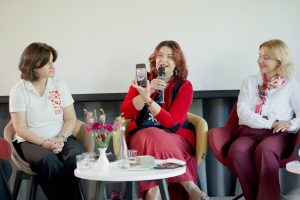
Maria Tytarenko, PhD, Associate Professor in the Department of Media Communications, UCU
Halyna Procyk, PhD, UCU’s Deputy Vice-Rector for International Cooperation, discussed how relationship pedagogy changed her approach to teaching her “Global Governance” course. After the birth of her daughter in 2019, she decided to go beyond merely reciting facts about international organizations and instead sought to “invite the world” into her classroom.
Two of her primary tools were the Model UN and COIL (Collaborative Online International Learning) programs, which facilitate joint online learning with university students across the globe. In Model UN, students represent not only familiar nations but also countries with vastly different historical, economic, and political contexts. This helps them understand both the official position of a state and the human element behind it.
“A true ‘we’ is born when individual ‘I’s can stand together and possess the inner freedom to hear and accept the position of another,” Procyk said.
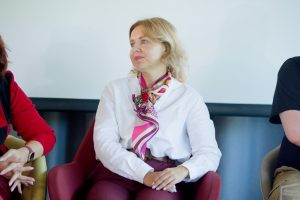
Halyna Protsyk, PhD, Deputy Vice-Rector for External Relations and Public Service
She noted that this is especially important during wartime, when there is a strong temptation to focus solely on one’s own experience and pain. Conversely, remaining open to the experiences of others helps build trust and genuine dialogue.
Oleksandr Avramchuk, PhD, Head of the Department of Clinical Psychology and the UCU Postgraduate Program in Psychology, addressed the “challenge of expertise.” He explained that positioning the professor as the person who “knows more” can create a disconnect with students. To counter this, he incorporates role-playing games and modeling into his courses. In these exercises, the professor must also remain authentic—for instance, by fully embodying the role of a person experiencing loss or depression.
“Relationships with a professor extend beyond the classroom. Sometimes they are born in an ordinary conversation, where you are not just an instructor, but simply a person ready to listen and respond,” Avramchuk said.
The panelists emphasized that relationship pedagogy is not a distinct methodology or a rigid set of techniques, but rather a way of being with another person. It involves recognizing their dignity, actively listening, making space for individual voices, and remaining open to continuous learning. Today’s professors face numerous challenges, including the ongoing war, generational shifts among students, the rise of artificial intelligence, and the constant need to rethink teaching approaches. In light of these challenges, the pedagogy laureates highlighted the critical importance of a teaching community where educators can share experiences, support one another, and collaboratively develop new practices.
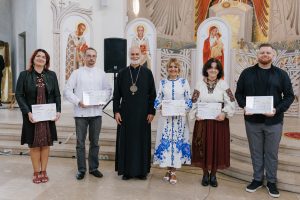
Fellows of the Metropolitan Gudziak Endowed Faculty Fund
Background Information: The Metropolitan Gudziak Endowed Faculty Fund is the largest endowment in the history of the UCU Foundation in the United States. It is designed to support faculty who follow the example of Archbishop Borys Gudziak by embodying the principles of the relationship pedagogy model in their teaching.
Each year, UCU selects faculty members to join the Relationship Pedagogy Nominees community. These individuals receive three years of foundation support for professional development and the implementation of teaching initiatives.
The creation of this endowment was made possible by the foresight and generosity of Christine and Adrian Slywotzky, who have supported UCU and its development across various areas for many years.
Text: Christina Kobak
Photos: Maria Urban