A panel discussion “Solidarity, Security and Resilience: Institutional Cooperation and International Partnerships” took place on March 7-14 at the Integral Human Development Forum 2026 organized by the Faculty of Social Sciences at UCU. International experts and diplomats took part in this event where they talked about solidarity as a security resource and a foundation for building sustainable interstate partnerships in the face of global crises.
Sophia Opatska, Vice-Rector for Strategic Development at UCU, noted that the university has publicly spoken about and written about solidarity not only in Ukraine, but also abroad.
“I love that there’s a lot of humor about our resilience. It helps us survive. While we joke about ourselves, we still understand that we are alive and stable,” stressed Sophia Opatska. “And our solidarity is wave-like: sometimes we support each other, stand in solidarity with each other, then we start to find out some things, but solidarity does not disappear entirely. Constructive conflict leads us to greater resilience.”

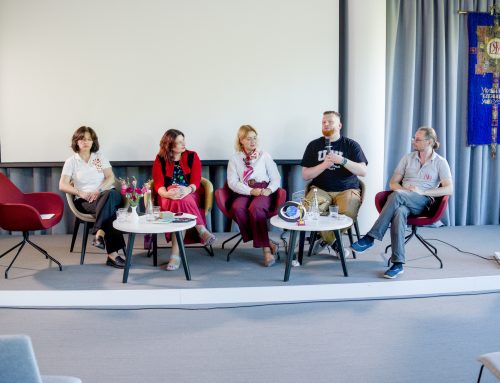
Panel discussion on “Solidarity, Security and Resilience: Institutional Cooperation and International Partnerships”
Volodymyr Turchynovskyy, Dean of the Faculty of Social Sciences at UCU, who moderated the panel, emphasized that solidarity should turn into infrastructure of security and stability. In his opinion, the most important question is how to do that.
Sanshiro Hosaka, Research Fellow at the International Center for Defense and Security (ICDS) in Estonia, said that the Japanese were victims of Russian propaganda for many years, but Russia’s full-scale invasion of Ukraine changed this.
“Japan rediscovered Ukraine for itself. Many Russian propaganda narratives have finally been debunked. Japanese society began to show sympathy for Ukrainians resisting Russian aggression. At the beginning of the full-scale invasion, blue and yellow flags could be seen even in small Japanese towns. And the Japanese mass media began to send their correspondents to Kyiv, and not to Moscow, in order to convey the Ukrainian position to the public,” said Sanshiro Hosaka.
He emphasized that close cooperation with Ukraine is not charity.
“Ukraine is not only a recipient of aid, but also a provider of knowledge, innovation and security. Ukraine has the strongest army in Europe. It has invaluable combat experience, as well as innovations in the field of drones and defense technologies based on artificial intelligence. So, without a doubt, these capabilities should be integrated into the future of Europe’s security architecture,” emphasized Sanshiro Hosaka.

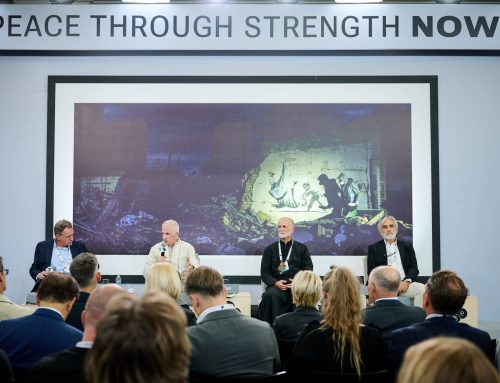
The audience listens to the panel discussion on “Solidarity, Security and Resilience: Institutional Cooperation and International Partnerships”
Hennadiy Kovalenko, Director at EDGE Autonomy in Ukraine, former Director of the International Defense Cooperation Department of the Ministry of Defense (2023-2025) and former Colonel of the Ukrainian Armed Forces, emphasized during his speech that we need a strategy in the war with Russia.
“Our bloody experience shows that the only strategy that works for Russia is the strategy of containment. It has three main components. First, international support is needed. The second is the stability of Ukraine, and the third is total defense. This is where total defense plays a key role,” Hennadiy Kovalenko noted.
He emphasized that war is a choice for Russians. For Ukrainians, it is a necessity.
“If Russia stops bombing us, the war will end. But if we, Ukrainians, stop fighting, Ukraine will cease to exist,” the colonel emphasized.
Luciano Monti, Adjunct Professor of European Union Policies at LUISS Guido Carli, emphasized: “Ukraine joining the European Union is not a manifestation of solidarity. This is a responsibility for the future security and well-being of Europe.”
According to him, Ukraine is currently going through extremely difficult times of war, which are difficult for the average European to imagine, but now is the time to think about how to integrate Ukraine into the EU in the future.

Students and staff listen to the panel discussion “Solidarity, Security and Resilience: Institutional Cooperation and International Partnerships”
Liubov Tsybulska, founder and director of “Join Ukraine,” founder and former head of Ukraine’s Center for Strategic Communication and Information Security under the Ministry of Culture and Information Policy of Ukraine (2021), emphasized during the panel discussion: “A sense of solidarity helps us a lot not to give up and to keep fighting. We call it sustainability.”
At the same time, she noted, Ukrainians are very tired of exclamatory and general words after a hard winter. We need something concrete and practical, like generators, interceptors, drones.
“Now such things provide us with both solidarity and stability. They guarantee safety, and safety today is everyone’s responsibility in society,” the expert emphasized.
According to Liubov Tsybulska, Russia often evaluates us according to its own logic and standards.
“They think that if the Ukrainian government collapses, the whole country will collapse. But in our country, civil society is a key pillar of the state’s stability,” the expert said.

Panelists of the panel discussion “Solidarity, Security and Resilience: Institutional Cooperation and International Partnerships”
Reference
The Integral Human Development Forum 2026 (IDH Forum 2026) “Solidarity in Times of Disruption” explores solidarity as an active force needed to protect human dignity, support resilience and shape a shared future. The contemporary world is going through a long period of profound disruption, shaped by war, political instability, social fragmentation, technological acceleration, and moral uncertainty. What once seemed exceptional is increasingly becoming structural.
The IHD Forum 2026 aims to create a space where solidarity is not only explored, but also practiced and communicated – through dialogue, education, collaborative research and public engagement. Ukraine’s lived experience of thinking, teaching and acting under conditions of war is presented not as a peripheral case, but as a vital source of insight for the global conversation on resilience, just peace and integral human development in an age of disruption.
Photo: Faculty of Social Sciences at UCU