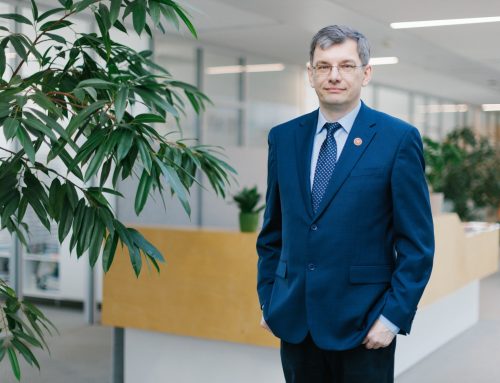
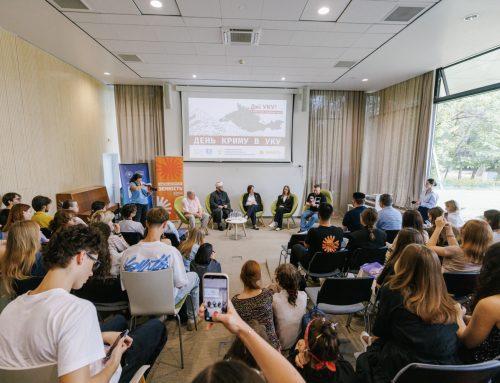
On September 14, Dr. Taras Dobko, Rector of Ukrainian Catholic University (UCU), spoke at the 33rd National Convention of the Ukrainian National Women’s League of America (UNWLA), held in Parsippany, NJ.
A translation of the full text of his speech follows.
—
UNWLA Convention Theme:
“Heritage and Strength: We Advocate, Educate, Cultivate, and Care”

Honored Fr. Oleh, Respected Presidents Emeritus of UNWLA Ms. Kurowyckyj and Ms. Zajac, Esteemed President Pawlenko, Honored Members of the UNWLA Board, Honored Head of the Ukrainian National Association Mr. Hirniak, Honored Ms. Lesia Harhaj-Kudryk of SUM, Honored Representatives of Selfreliance Federal Credit Union Chicago, Dear Members of UNWLA, and Dear Friends,
Glory to Jesus Christ! Glory to Ukraine!
I sincerely congratulate you on the 33rd National Convention of the Ukrainian National Women’s League of America. For me and Ukrainian Catholic University it is a great honor and pleasure to take part in your assembly today. UNWLA will mark its great jubilee next year. May this year that will bring us closer to it be for UNWLA and its partners a year to dream bravely and gather strength for the next century of UNWLA’s glorious activities.
We are approaching the 1000th day of Russia’s full-scale war against Ukraine. One thousand days of air raid sirens throughout the country, 1000 days of suffering, terror and death. Two weeks ago, we began the new academic year at UCU. It was a very difficult beginning, an emotional seesaw, from deep joy and happiness to unspeakable sadness and grief.
UCU this year has 470 new bachelor’s and 360 new master’s students. This is more than last year. We are glad that young people and their parents trust UCU, especially in wartime, especially in a situation when sociological polls demonstrate that 30% of school graduates intend to leave the country to study abroad. I strongly believe that UCU plays a key role for many young people in their conscious choice to remain and to receive a quality education in Ukraine.
Nevertheless, today we live in the realities of war, which has a great destructive influence on our people. It ruins infrastructure, destroys life, separates families, and makes children orphans. War ruins the social order and negates the rules of the game and cultural codes which make our life understandable and customary. War also destroys moral principles and ruins souls and worldview. It dehumanizes people, makes them insensitive to their God-given human dignity. War takes people away from the UCU community…
One of our doctoral students, Mykola Hayevoy, perished in the fighting in the Kursk area on August 27. He was a very talented historian. He was legally excused from military service but voluntarily went to the front the first day of the invasion. And on September 4 one of our students, Daria Bazylevych, and her mother and two sisters died because of a missile attack in Lviv. Daria was a second-year student in the Culture Studies program. She participated in theater and had many dreams. Our students, who en masse took part in the funeral, will be different people after this experience…
In connection with this, we again recall the words of Mahdalyna Dymyd, an UCU student who described her generation as young people who more often attend the funerals than the weddings of their friends. Already 32 members of our community (12 graduates) have given their lives for our freedom and dignity – our students, graduates, husbands and brothers of our co-workers, and fathers of students. In order to crown their memory in our community, we decided to establish endowed scholarships to honor the memory of deceased UCU graduates. Please remember them in your prayers.
A key question that arises during this war in Ukraine is where to find the strength to continue, to overcome obstacles, to act despite uncertainty, to dream despite all our troubles, and remain humane even in the face of shameless evil.
We find strength by considering our God-given dignity, which no despots or tyrants can take away from us. Russia wants to deprive us of this dignity. It is waging an aggressive war against this dignity. Respect for human dignity and human life is the basis of our democracies. This is what makes an incredible difference between democratic countries and Russia. For many Ukrainians, this war has not only been a trial but a deep experience of their dignity. If a person realizes his or her God-given dignity and maintains it, he or she is able to overcome fear and oppose injustices in a morally convincing way. It is no surprise that many people in Ukraine often behave like the first Christians, who maintained their convictions despite all persecutions and difficulties. I expect that Ukrainians will preserve this experience of dignity and incorporate it into social structures and institutions in post-war Ukraine.
Our Ukraine is now a laboratory. Many experiments and tests are happening here: tests of the strength of world democracy; tests of Ukraine’s spirit and strength; tests of the sustainability of businesses; tests of new types of weapons and ways to conduct war; tests of new ways of providing electrical energy; tests of humaneness and mutual cooperation. I hope that the time will come when we in Ukraine will test modern types of cities and villages, modern approaches to education and modern approaches to developing society. It is urgent now to look for, research, and find these new approaches and to be prepared to implement them.
We think that today each university in Ukraine should find its own answers to three questions: (1) What is my role in healing the wounds of war? (2) What is my role in rebuilding and renewing the country? (3) What is my role in strengthening international awareness, support, and solidarity with Ukraine? As universities, we do not have a great choice on what our strategic attention should be focused. We can only choose how to do this.
We at UCU are doing much for this goal. I can’t list everything here. We have opened a medical clinic focusing on physical rehabilitation. We have created an Alliance of Ukrainian Universities focusing on work with local communities and strengthening their ability to be renewed. In the orbit of UCU there are already more than 50 communities with whom we’re interacting in response to their specific needs. We already have an Office for the Affairs of Veterans and Their Families. In particular, we have developed an online course “Veterans in the UCU community,” where we want to show how to overcome certain barriers when civilians interact with veterans, to give advice on interacting with veterans at work or in the classroom. There are also popular courses in the series “Returning from war” on the UCU online platform: “Mind, body, society” and “First steps in IT.” In the same vein, the Applied Sciences Faculty conducted a half-year course for veterans “From the Frontline to Data Science Consulting,” which 23 people completed. The Center for Children’s Dignity is conducting educational programs and developing policies to prevent violence in church circles and educational and health care institutions. The center developed a wonderful online course “The child’s safety in the educational environment.” We are preparing to launch a School of Integrated Development, focused on distributing a menu of programs in adult education, for example management programs for leaders of city government, school directors, leaders of health care institutions, etc. We are doing much work to advocate for the Ukrainian agenda in the global arena through our centers in London and Wroclaw, through the development of Ukrainian studies (for example, at The University of Notre Dame), and through strengthening contacts with universities of Latin America and Asia (Colombia, Peru, Indonesia, Japan, etc.).
Today I would particularly like to mention two large projects supported by UNWLA and their role today. I have in mind the UNWLA Center for Women’s Studies at UCU and UCU’s Mental Health Institute. In the context of this great war, it can be said that, in its time, UNWLA’s decision to support these two initiatives was prophetic.
Every institution in Ukraine today faces the questions: How to lessen the war’s destructive influence on people? How to increase their resilience? Where to find strength? How to encourage people’s revitalization? What should be done to heal the wounds of war? How to prepare people to rebuild the country?
One of UCU’s first steps was including the experience of war in educational courses. In tragic circumstances, students feel more strongly the relevance of their education. The question “for what purpose” becomes particularly acute. It is necessary to respect the student’s situation and, by transferring educational content to the materials of war, to help pass through the inevitable crisis of the relevance of education. This also helps young people find answers to complicated questions in life: loss of those close to us, to remain or to leave, what does justice require, etc. Project-oriented education, where the project is an activity aiming to help soldiers, veterans, internally displaced persons, children or others suffering because of the war, has become useful in this situation, or an activity aimed at fighting the lies of the enemy’s propaganda, so-called “fake news.” You are certainly aware that Putin and his disinformation network all through Europe and here in America support this with hundreds of millions of dollars. In a similar way, we are trying to present the tasks of rebuilding and renovation in the development of content and methods in our educational disciplines.
UCU’s Mental Health Institute plays an important role here. In wartime it is adapting its traditional programs “Psychology for life” and “Mental health in the work place” to today’s circumstances. The institute has also become leader in a number of exceptionally important national projects.
Thus, at the request of the Synod of the Ukrainian Greek-Catholic Church in cooperation with the Commission on Pastoral Ministry in Health Care, we have developed and launched a program for priests “Healing the wounds of war,” a program to provide psychological first aid. More than 600 priests have studied in this program. All are required to go through this program.
The Mental Health Institute coordinates the introduction of programs of holistic mental health care at UCU. The concept has been developed and approved and education is being provided to staff and students. At the Horizon of Hope consultation center for mental health and trauma therapy, UCU staff and students and also veterans and members of their families can receive consultation. In the academic year 2023-2024, approximately 700 cost-free consultations were provided for veterans and 428 in the year for UCU students and staff. In addition, in February 2024, together with the Coordinating Center for Health Care at Kyiv-Mohyla Academy, UCU conducted a meeting for rectors of Ukrainian universities to familiarize them with UCU’s experiences. Experts from the Mental Health Institute support the development of a holistic system of mental health care in institutions of higher education in cooperation with Ukraine’s Ministry of Education and Science.
The Mental Health Institute has influence at the national level for the further development of reform, for the development of national programs to foster resilience, to heal the wounds of war, etc. Experts from the institute of have been engaged in Ukraine’s national program for mental health as part of Olena Zelenska’s initiative “How are you?” This simple question and interest in a person’s psychological state can reveal very deep emotions and help the person on the way to healing soul and body. In 2023 and 2024, the institute initiated and conducted two conferences on resiliency. Books on resiliency, loss, and other important themes have been translated and published. Inasmuch as Russian-language professional literature continues to dominate the Ukrainian market, it is worthwhile to substantially increase the publication of series, in particular for experts, but also for the general public. A particular focus is on themes connected with healing the wounds of war.
In 2023, experts from the institute took part in writing a comprehensive program of mental health and psychosocial support for the Lviv Region. In summer 2024, the institute brought together experts from within and outside UCU with the goal of developing recommendations for programs in mental health and psychosocial support for the Zaporizhzhia and Kherson regions.
We understand that a key challenge for Ukraine’s post-war rebuilding will be the availability of capable, hard-working, dedicated people. We also understand that women will play a leading and significant role in the post-war renewal. Their participation and involvement will be important in rebuilding communities, renewing infrastructure, fostering social cohesion, and stimulating stable development. So the theme of women’s leadership, women’s initiatives, is extremely important. Various divisions of UCU are working on this together with the Women’s Studies Center. At the initiative of the Business School, conferences on women’s leadership have been held. An educational program “Women’s leadership and managing change” has also been offered a number of times.
Today in particular it is necessary encourage young women to choose to study in traditionally “men’s programs.” To promote stereotypically “men’s professions” among women, educational work is necessary, as is appropriate professional orientation for incoming students and their parents. The presence of women in male-dominated professions will positively influence change. Examples at UCU are the Ethics-Politics-Economics and Computer Studies programs, where there is a good balance of young men and women.
I will mention that one of the main projects at UCU’s Women’s Studies Center is the Lectureship, which is part of UCU’s educational program, open to students in all fields of study. The goals of the Lectureship are: academic activity connected with research, teaching, and the popularization of Women’s Studies; acquaintance with worldwide methodologies in this area; encouraging research in women’s themes in social, economic, historical, and theological aspects; and turning society’s attention to questions of dignity and the integrity of the human person and fostering equal conditions for women’s professional, social, and spiritual development.
The academic program of the UNWLA Women’s Studies Center at UCU includes elective courses for students of the bachelor’s and master’s programs. When we consider today’s tragedy of the full-scale war of Russia against Ukraine, it is particularly worthwhile to note the courses and research of Tetyana Lapan “Oral history as a method of researching women’s participation in the current war in eastern Ukraine” and of Oksana Dudko “Women and violence in the 20th century.”
In addition to courses for students, the center organizes and conducts open lectures, seminars, round tables, and conferences to popularize the theme of women’s studies in the humanities today. In October 2022 in UCU’s shelter, the conference “Woman in early modern society on the territories of the Polish Commonwealth” was held. According to its results, a collective monograph of the same name was prepared for publication and, by the end of the year, it was published by the UCU Press. At the end of August 2023, together with the European Society of Women in Theological Research (ESWTR) UCU organized an international conference “Imperial Powers and Women: Trauma, Resistance, and Resilience,” which assembled some 60 participants from all Europe. This conference was a discussion forum to broadcast the Ukrainian position and an understanding of just peace; it provides examples of women’s fight against aggressor Russia and examples of solidarity. In April 2024, an exhibit about the travelling choir directed by Oleksandr Koshyts, “They came! They sang! They conquered!” reached a large audience.
In conclusion. So that Ukraine wins the war and achieves a just and lasting peace, it is important to have the support of civic thought in the West and to combat “Ukraine fatigue.” Civic thought about the support of Ukraine is a no less important factor in Ukraine’s victory in the war than military and economic aid. I worry that there is a tendency to pressure Ukraine with the goal of accepting a peace agreement even at the cost of loss of territory.
What can we do together to combat “Ukraine fatigue”? It’s important that the West rids itself of its illusions, stereotypes, and fears regarding Ukraine and Russia. Our task is to help in this. Russia trades on fears. Russia feeds fear, especially in the West. It threatens people in democratic countries with the prospect of a military conflict between NATO and Russia. It frightens the West with the prospect of a Third World War, and even a nuclear war. But “let us never negotiate out of fear” (from the inaugural address of President John F. Kennedy). From the spiritual point of view, the best way to rid one’s self of fear is to meet and conquer it with meaningful action for the sake of good.
Allow me to share the story of Fr. Herman Budzinskyi. He was an underground priest during the Soviet persecution of the Ukrainian Greek-Catholic Church. Over a period of four decades, he was arrested a number of times and unjustly sentenced. He spent many years in prison. After this, as Fr. Herman was released after one of his terms in the GULAG, he began to collect Soviet magazine articles which slandered the Church. He then sat down and wrote thorough rebuttals of the slanderous texts and sent them to those very media outlets. For this, he was again arrested, sentenced, and sent to prison. After the fall of the Soviet Union, they asked him why he stood against the Soviet authorities so many times, why he was not afraid. Fr. Herman responded: “In fact, I was afraid. But what consolation I felt when I conquered my fear. What happiness I felt when I was freed from it!”
We live in the realities of a brutal war. There are many reasons for worry, disappointment, frustration, lack of faith, and even despair. Today, as never before, we feel our vulnerability and limitations, our dependence on forces beyond our control and a lack of control over our future, and the fragility of our dignity. In such difficult conditions, hope should be a way of life for us. And our university, and UNWLA, should be a source of hope for others.
When Head of the UGCC Sviatoslav Shevchuk asked how to best serve the residents of the capital in the difficult times of war, Kyiv Mayor Vitali Klitschko said: “More than bread and clothing, what we need from the Church is a word of hope. Be signs and messengers of hope!”
The UCU community has dedicated this academic year to the theme of hope, because those who have hope live differently! For us this year, hope will not simply be a theme for reflection but an inspiration for the interior life of our hearts and a goal for the works of our hands. This year we will particularly reflect on what it means to be people of hope, a community of hope, an institution of hope.
Let us together be messengers of hope, in the land of Ukraine and beyond!