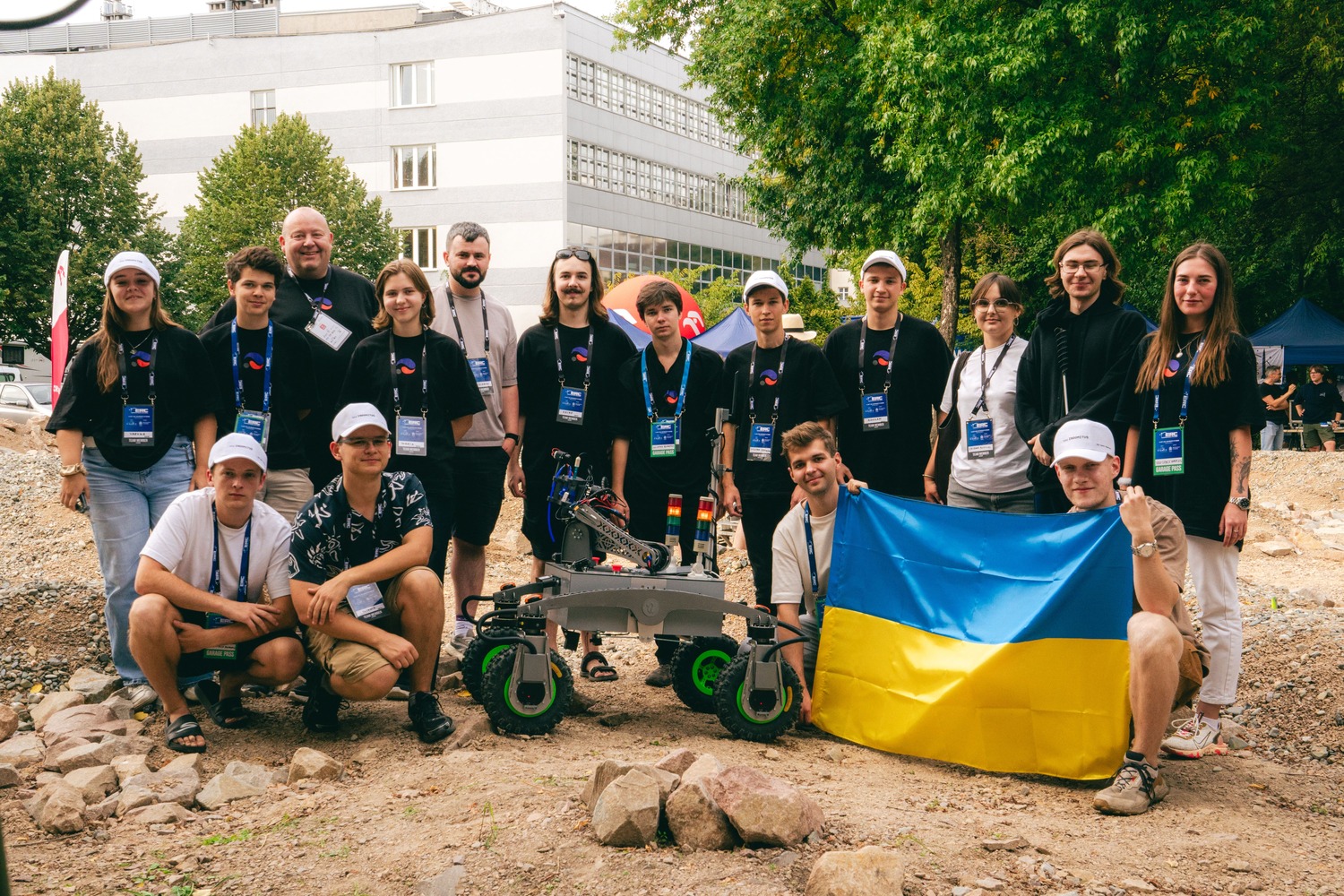
The UCU Space Robotics team of the Ukrainian Catholic University has completed its participation in the European Rover Challenge 2026, an international space robotics competition held from September 4–6 in Krakow, Poland. In its debut year, the team advanced to the finals among 124 teams and improved its position from 25th to 20th during the competition. For the team from the Faculty of Applied Sciences, this outcome was the result of six months of intensive work—spanning from the initial idea to participate in the ERC to the creation of a full-fledged Mars rover, Indomitus, and its testing in the competition finals.
The Ukrainian Catholic University (UCU) Space Robotics Team at the 2026 European Rover Challenge
Indomitus is a Mars rover created by students to perform tasks modeled after planetary mission scenarios. It traverses complex terrain, executes navigation tasks, collects and transports samples using a manipulator arm, and operates in conjunction with a reconnaissance drone. During the ERC, the team tested not just individual mechanisms, but the performance of a complete system: from communication and navigation to mechanics, electronics, and autonomous behavior.
Gradually, other students and mentors joined the project. Today, UCU Space Robotics unites 25 students from the Computer Science and Robotics programs and five mentors (Oleg Fareniuk, Andriy Ozhovych, Oleksandr Shevchuk, Svyatoslav Paliy, and Yaroslav Oleksiuk). The team is divided into several specialized subgroups responsible for different components of the Mars rover: software, electronics, mechanics, and other engineering disciplines.
The primary mentor of the project is Andriy Ozhovych, and coordination of the student team was managed by Mykola Balyk, a third-year Computer Science student.
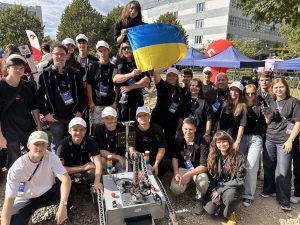
The Ukrainian Catholic University (UCU) Space Robotics Team at the 2026 European Rover Challenge
During ERC 2026, the teams performed eight distinct tasks simulating the operation of a Mars rover during a Martian mission. These included scientific surface research, soil sample selection and analysis, the search for potential biological markers, autonomous navigation of the Mars Yard, area reconnaissance using a drone, technical operations with a manipulator, sample search and collection, and the presentation of custom engineering solutions to the jury. The evaluation criteria included system operation accuracy, autonomy, task completion speed, and the team’s ability to articulate their technical solutions. UCU Space Robotics performed best in the final task—Probing—which involved searching for and collecting specific samples. The rover had to rapidly locate designated objects, grasp them with its manipulator, and deliver them to a container. The team completed the task with a maximum score of 200 out of 200 points.
“The most difficult part was managing critical situations. This was especially evident during the final week before departure and throughout the competition. When an important and expensive component that is not in stock fails, you need to find a solution very quickly. Our team handled this exceptionally well: some members analyzed the cause of the breakdown and explored repair possibilities, while others sought replacements by contacting different teams and stores. We did not let problems halt our progress; instead, we immediately explored various solutions,” says Yaryna Zabchuk, a third-year Computer Science student and member of the UCU Space Robotics team.
Participation in the ERC provided the team not only with an opportunity to test Indomitus in real-world conditions, but also served as their first experience competing against university teams that have spent years developing their own space robotics programs.
“We didn’t set out with the goal of winning; we simply tried to do our job as best we could. So, when we realized we were the first to cross the finish line and that everything—from communication to mechanics and electronics—worked seamlessly during those five minutes, it was a moment of immense joy and pure euphoria. That was when we truly felt what we had been working toward for all these months,” adds Yaryna.
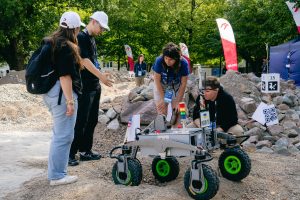
The 2026 European Rover Challenge
Among the leaders of this year’s competition were teams from EPFL in Switzerland, AGH University of Krakow in Poland, and the DIANA team from Italy. For UCU Space Robotics, however, this was a debut season.
“We are incredibly proud of our students. In six months, they went from an idea and a dream to the finals of the European Rover Challenge, breaking into the top twenty out of 124 competing teams on their very first attempt. Ahead of them were teams with years, and sometimes decades, of experience and significantly greater resources. But for me, the most important thing isn’t even our placement on the leaderboard. This is what university education should be: not just lectures on theory, but a laboratory, a team, and a complex challenge that students tackle together. Today, this challenge led them to the ERC finals, and tomorrow, I hope it will lead to even more ambitious engineering projects,” said Yaroslav Prytula, First Vice-Rector of UCU and Founding Dean of the Faculty of Applied Sciences.
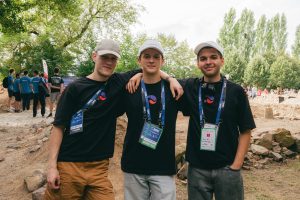
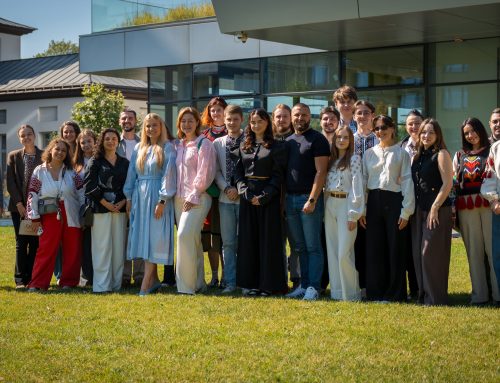
Participants in the 2026 European Rover Challenge
For the participants of UCU Space Robotics, the project offered a practical opportunity to apply knowledge gained from coursework to the development of a complex, real-world technical system. Throughout the project, students combined multiple engineering disciplines, coordinated work across sub-teams, operated within limited resources, and continuously refined the rover’s design.
“Over the past six months, the students traversed a path that is difficult to replicate within a standard training course: from an initial concept to a sophisticated engineering system that had to be designed, assembled, tested, and operated under international competition conditions. For us, this is the greatest value of such projects. Students learn not only to devise technical solutions, but also to collaborate as a large team, take responsibility for their specific component of a shared system, and bring an idea to tangible fruition,” says Oles Dobosevich, Dean of the Faculty of Applied Sciences at UCU.
One of the team’s long-term objectives is the ongoing development of student robotics at UCU. With the recent launch of the Robotics undergraduate program at the Faculty of Applied Sciences, the team is committed to making large-scale engineering projects a cornerstone of the student educational experience.
Following the ERC, the team plans to continue developing Indomitus, leveraging the competition experience to improve the rover for future stages. Initially, students and mentors will address components identified during the finals and continue testing both individual systems and the integrated rover. Special emphasis will be placed on training rover and manipulator arm pilots, as well as advancing autonomous navigation and robot behaviors—areas the team considers vital for securing top placements in the future.
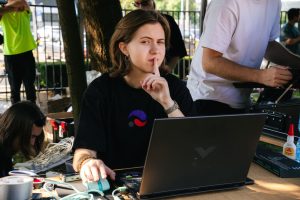
The 2026 European Rover Challenge
Concurrently, UCU Space Robotics plans to expand its membership. Sub-team leaders will soon define role requirements and necessary skill sets to select new participants from the first- and second-year cohorts. The team aims to model this expansion on a professional engineering organization, featuring distinct roles, clear areas of responsibility, and rigorous standards.
Another key priority is securing new partners and sponsors. The team is currently preparing presentation materials and proposals for potential partners who can support the project’s continued growth.
Looking further ahead, UCU Space Robotics is determined not only to return to the European Rover Challenge, but also to compete in other international space robotics events.
We extend our gratitude to the partners who believed in the team and supported this project: Ukrainian Catholic University, Nova Ukraine, SoftServe, ELEKS, and Infineon. Their support was instrumental in enabling the students to journey from an initial concept to the finals of the European Rover Challenge.