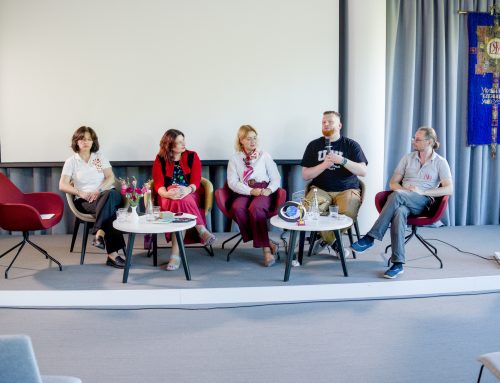
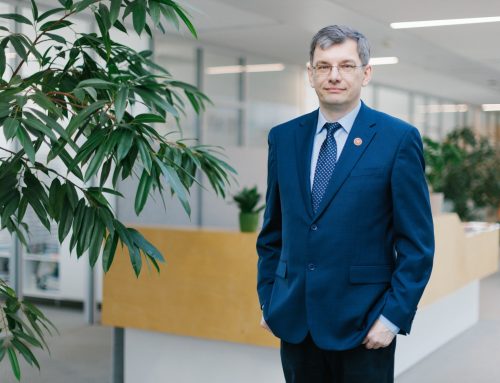
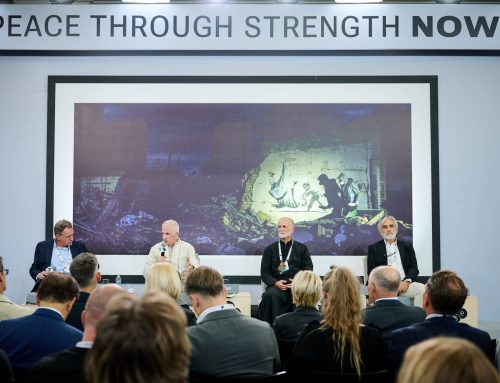
The Ukrainian team of students from Ukrainian Catholic University received four awards at the prestigious international educational role-playing game whose participants imitate sessions of various structures of the UN system, National Model United Nations. Three awards were for best position papers in committees and one was for the exceptional work of the whole delegation. Five students of Ukrainian Catholic University spent a week in New York, where they modeled the mission of the Republic of Cyprus in three subcommittees of the General Assembly and also the office of the United Nations High Commissioner for Refugees (UNHCR).
The National Model UN is the oldest and largest global conference Model UN in the world, functioning since 1927. Yearly it holds global conferences in which youth from more than 120 countries travel to participate. These are students from leading universities where they have model UN practice as an academic course or as a student club or extracurricular activity.
In this way, the National Model UN is the main forum where young diplomacy develops. Many countries here prepare teams for their future diplomatic resources.
Before 2020, Ukraine did not take part in this conference. Then UCU developed a partnership with the Ukrainian Resource and Development Centre and the MacEwan United Nations Club at MacEwan University (Canada). They helped open up this project to Ukraine.
Because of Covid, Ukraine’s first model in New York was held in a hybrid format. Until 2025, UCU students formed a joint team with colleagues from the National University Kyiv-Mohyla Academy.
This year the Ukrainian Catholic University team traveled to the model as a separate delegation. This was the largest conference in history, with 3 000 delegates taking part.

The UCU team won four awards at the National Model UN
Halyna Protsyk, head of the delegation, UCU Deputy Vice Rector for Outreach and Social Engagement, and an UCU professor, admitted that at first the large number of participants was intimidating. But seven months of preparation played an important role in their victory.
“We worked in stages: They prepared position papers, researched the country to which they were designated – the Republic of Cyprus, and had a number of important meetings with other delegations,” said Halyna Protsyk.
She explained that, in the model UN, university teams represent the country to which they’ve been designated in various UN committees in which the countries take part in real life.
Because of its small size, the Ukrainian team had the opportunity to work only in four out of sixteen committees. Each committee has its agenda, questions which are considered at the global level.

Halyna Protsyk
The task of the team from Ukraine was to research how the Republic of Cyprus positions itself as a member-country of the UN in certain problematics. The students studied politics, history, the position of the country, various internal and external political contexts, and economic and social aspects.
“It’s a very difficult task. In addition to this research, it’s also necessary to form ideas which the Republic of Cyprus can propose to resolve these situations, for global communities, and also to become fluent in knowledge of all the rules and procedures in the process of multilateral negotiations,” admitted Halyna Protsyk.
Yelyzaveta Tkach, head of the delegation of the university team and a student in UCU’s Ethics-Politics-Economics bachelor’s program, added that the position paper which condenses the country’s position regarding these questions should not only be the result of research into Cyprus but should show the delegate’s contribution in ideas and development.
“Awards are given not only for the ability to ‘Google’ well, but for creativity, professionalism, and a sense of appropriateness, your contribution as a delegate to strengthen the diplomatic position of Cyprus,” said the student.

Yelyzaveta Tkach
In the results of the conference, the UCU team won three individual position awards for the best position paper on the committee and an award for the exceptional work of the whole delegation, an honorable mention.
Each committee had from 200 to 300 people on it. Approximately 10% of the committee members received awards.
“Participants are assessed on very precise criteria: academic mastery, well-grounded research, realistic ideas which develop global mutual understanding, no use of AI, and compliance with certain technical criteria for document writing,” said Halyna Protsyk.
Individual position awards were presented to UCU students of the bachelor’s program Ethics-Politics-Economics Yelyzaveta Tkach, Valeriya Levchyshyna, Tayisiya Obod, and Viktoriya Deshchakivska, a student in the Master’s Program in Public Administration.

National Model UN
Yelyzaveta Tkach was on the third committee of the General Assembly on social and cultural questions, where they considered questions of aid to refugees and internally displaced persons, and also human rights to access to drinking water and sanitation at a global level.
“My document was noted for the originality of ideas. I tried to present the unique perspective of Cyprus and show that it can propose something exceptional. In the theme of water, I focused on the fact that Cyprus is an island nation, and problems with access to water there relate to climatic conditions and geographical position. In the theme connected with refugees, I focused attention on the occupation of part of Cyprus which has been going on for more than 50 years and on the problems of migration and internal displacement,” explained Yelyzaveta Tkach.
Valeriya Levchyshyna was at the office of the United Nations High Commissioner for Refugees (UNHCR). There they considered the theme of stateless persons and ways to reduce their number. They also discussed gender-based violence against refugees and internally displaced persons.
“It’s important that Cyprus does not have a noted position in these questions. So it was difficult to find out in what way this country could influence the general agenda. When I researched the legislation of Cyprus, it turned out that there is no definition of stateless persons at all. Accordingly, the country cannot accept basic conventions on this question,” said Valeriya Levchyshyna.

Valeriya Levchyshyna
The student admitted that during committee work her idea on expanding the term “stateless persons” was accepted in all resolutions. This was an important point, which was in agreement with the ideas of everyone else.
Tayisiya Obod and Viktoriya Deshchakivska worked together in the second committee of the General Assembly, which was responsible for questions of economics. There they considered the priority of sustainable production and consumption over reducing a financial deficit and also the encouragement of sustainable models of production and consumption.
“It was very difficult to understand which particular trait of Cyprus we could suggest. Cyprus is a country that belongs to the European Union, and it will support EU programs. But they decided to talk about the specifics of the area’s location. Cyprus has a very fine climate. So we developed the idea of cooperating with the private sector in the area of establishing and using solar panels,” said Tayisiya Obod.

Tayisiya Obod
Viktoriya Deshchakivska added that, during committee work, they looked for unique particularities of Cyprus which they could show to other countries.
“Before the conference, we did preparatory reading, analyzing the documents of other delegates in order to understand who would be a good partner for us. So we knew with whom it was worth working. It was also very interesting to interact with delegates, to understand their positions. That is, we not only demonstrated analytical abilities but also communication skills,” noted the student.

Viktoriya Deshchakivska
The fourth award the team brought back was for the delegation. To receive this award, each team member had to stand out during committee work. Here they assessed diplomatic protocol and etiquette, diplomatic behavior, active development, and lobbying of interests.
Dana Bilichenko, a team member from UCU’s Ethics-Politics-Economics program, explained that for a small team with five people to stand out among such a large amount of participants is fairly difficult, though the UCU students handled it well.
“Our main task was to enlist the support of the largest amount of members of other delegations. It was necessary to approach each committee member, present the ideas that your country was offering, find common points of contact and questions where your positions did not overlap, and after this to come to an understanding,” explained Dana Bilichenko.

Dana Bilichenko
The National Model UN was a good opportunity for the Ukrainian team to present not only Cyprus but also Ukraine during informal sessions and discussions.
“We carried out an educational mission and explained to colleagues from various parts of the world much about Ukraine, about our university, about the resilience of higher education, about the context, about how our students live and study in Ukraine during the war. We also built friendly relations, looked for new friends and contacts in various countries,” noted Halyna Protsyk.
Yelyzaveta Tkach agreed that informal interactions were opportunities to remind people that the war in Ukraine continues.
“After hearing our accounts, people’s understanding of the situation changed, and the war in Ukraine became closer to them, and not something incomprehensible and far away. Because they saw their peers, who live in constant danger, and thought about how to explain this to friends at their universities. I think that on this level this is also part of our mission,” emphasized Yelyzaveta Tkach.

National Model UN
“Trips like this help us develop a circle of partnerships. We came to this conference knowing that friends from Japan, Germany, the United States, Canada, and other countries were waiting for us there. And every year you develop this environment of partners and this solidarity, because you share stories. This is witnessing, serving, and communicating, which we carry out as a mission. I want everyone to understand that, in fact, our participation in this model is analogous to what our ongoing representation does in the UN system in general,” emphasized Halyna Protsyk.
She compared the resources of Ukraine and of Russia at the UN: “Our delegation is a team of super-professionals with a maximum of 10 people. But the Russians in their headquarters alone have more than 120. Such unequal resources are like the fight of David and Goliath. But this is also the idea and the action of a ‘non-standard David,’ about which leading business consultant and author of bestsellers in strategic management Adrian Slywotzky says: ‘The quality of resources and talents is much more important than the amount.’ All the people we work with – those who helped us implement this project, and how we work, witness, serve, communicate – this is the goal which will always distinguish us from other teams. And this will now work in synergy with our ongoing representation. Because when they look at us, they see themselves, and this gives very much hope.”
Nadiia Ilchuk wrote this article.
Matthew Matuszak translated it.