“I want you to know how much you and the people of this country are in our prayers and in our thoughts at this difficult time. We can’t bear the burdens that you bear, but we do feel a deep connection with you and support for you, and we know that this people and this country will overcome the challenges it faces. So God bless you all. I hope that you will manage to find a just peace, a peace which will allow Ukraine to be free.” Fr. John I. Jenkins, 17th president of the University of Notre Dame (USA), during his visit to Ukraine.

Fr. John Jenkins at the Field of Mars in Lviv
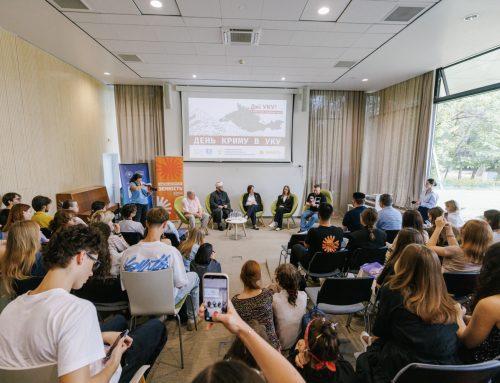
Fr. John Jenkins traveled to Lviv and Ukraine in a visit of solidarity and support. On 31 August, he visited the Field of Mars military cemetery in Lviv, the national center of Superhumans, the Garrison Church of Sts. Peter and Paul, and he took part in a discussion as part of UCU Days “How do Catholic universities create social narratives, counteract the polarization of society, and foster national unity?”

From left to right: Irene Galadza, catechist, church activist; Fr. John Jenkins, 17th president of the University of Notre Dame; and Larisa Galadza, Canadian Ambassador to Ukraine (2019 – 2023).
Together with UCU Senator Larisa Galadza and Irene Galadza, Fr. Jenkins began his visit with a memorial service on the Field of Mars in Lviv, where new Ukrainian heroes, who perished in Russia’s war against Ukraine, are buried.
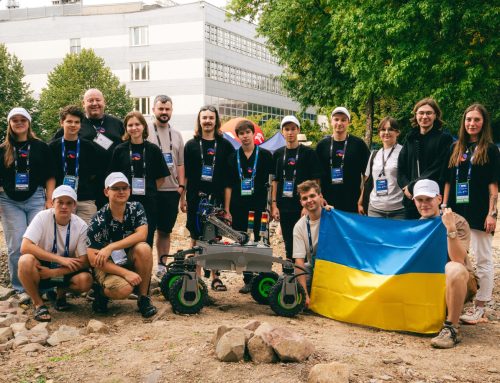
The delegation then visited Superhumans, a national center for prosthetics, reconstructive surgery, rehabilitation, and psychological support for adults and children who suffer from the war. There they spoke with soldiers who are undergoing rehabilitation after they were wounded, in particular with UCU graduate Oleh Tsunovskyi, soldier and doctor of Eastern Christian Studies.

The delegation visited Superhumans.
“You read the newspaper, and you get an abstract sense of what’s going on in Ukraine, that this battle happened, that there’s this bombing… But you go there and you see actual people who are casualties of the conflict, those who are giving their lives. Coming here, you can see the human cost of war. Their sacrifice will help Ukraine remain free,” said Fr. Jenkins. “At the Superhumans rehabilitation center you can see those who have lost limbs and those working on their rehabilitation. Even in the midst of suffering, people can find in themselves the ability to be human beings, dignity, strength, witness, inspiration. We don’t so much need words as examples of courage, persistence, and care for one another. And today I see concrete examples of how people can change other people.”

The delegation visited Superhumans.
Fr. Jenkins is also convinced that the war in Ukraine is not only a problem for Ukraine but for the whole world, and so it’s necessary to display solidarity and join efforts in the fight: “The notion of solidarity means we’re all connected in an important way, and the struggles, the injustices of the people of Ukraine, are our problem and something we should be concerned about as well. It’s not just another part of the world. These are human beings that are part of the human family, so it’s a reminder that we’re all interconnected, and we must always remember that, and never tire of working for justice and working for peace around the world.”

At the Garrison Church of the Apostles Sts. Peter and Paul.
The delegation also visited the Garrison Church of the Apostles Sts. Peter and Paul. “The face of our heroes is the face of freedom, democracy, and dignity.” So said the pastor of the garrison church, military chaplain Fr. Taras Mykhalchuk, during the tour.

At the Garrison Church of the Apostles Sts. Peter and Paul.
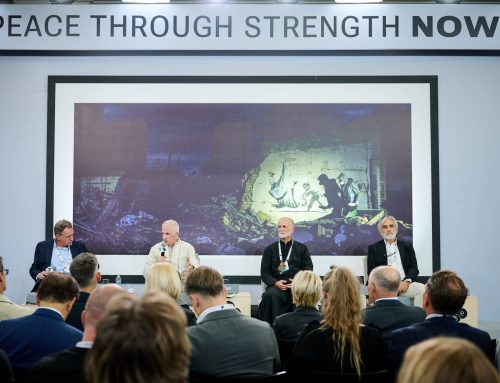
Then Fr. Jenkins and Archbishop Borys Gudziak took part in a meeting with UCU graduates, discussing the role of Catholic universities today. Sophia Opatska, UCU’s Vice-Rector for Strategic Development, moderated the discussion. Responding to Opatska’s question about UCU’s connection with Notre Dame, Fr. Jenkins emphasized that the University of Notre Dame feels a special connection with Ukrainian Catholic University.
“There are many Catholic universities, but I feel that the strength of the vision and the power of the vision of UCU is something with which we resonate. We feel a bond… What we try to do at Notre Dame, as at UCU, is to provide something different, something special to our students, to our alumni, and to the society and to the Church, all of which we serve and all of which are our constituencies… What we provide at Notre Dame and what UCU provides is a sense of purpose in education and life,” said Fr. Jenkins.

Fr. John Jenkins
In his opinion, most universities, especially in the USA, provide knowledge, expertise in an area which can be used to get a job and have a career:
“And there’s nothing wrong with that,” he noted. “But I hope that Notre Dame and UCU challenge our students to think about a broader purpose to their lives, a broader meaning, that is valuable and powerful and transformative… And also what I find at UCU and see at Notre Dame is a sense of community, a sense that people come together not simply to occupy the same space, but with a sense of community.”

Fr. John Jenkins
Archbishop Borys Gudziak added that “our strength comes from our communion, and the best way to face these difficulties, the horrific destruction, the death, the injustice, is to do it together.”

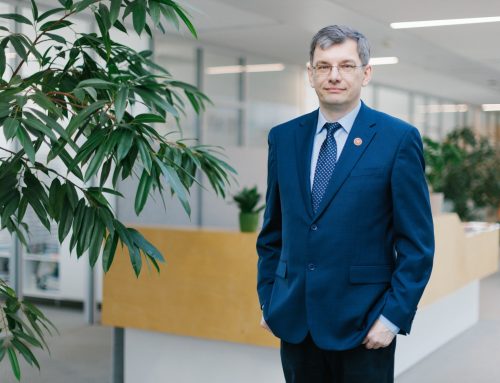
Archbishop Borys Gudziak
Fr. Jenkins also spoke to the graduates, who, he is convinced, form the most important “advertisement” for any university, namely, its reputation.
“Alumni are the best and most important advertisement for the university. So simply be capable in whatever field you work in and bring to that a certain higher purpose… Help students after you acquire a quality education… UCU cannot do its work except through the generosity of people. Archbishop Borys and I look like we’re leaders here, but we’re really, in our hearts, beggars. We try to appeal to people’s generosity… To the extent you can, and your primary commitments are to your family and yourself, but, to the extent that you can, do help the people who come after you get the education you received,” emphasized the former president of Notre Dame.

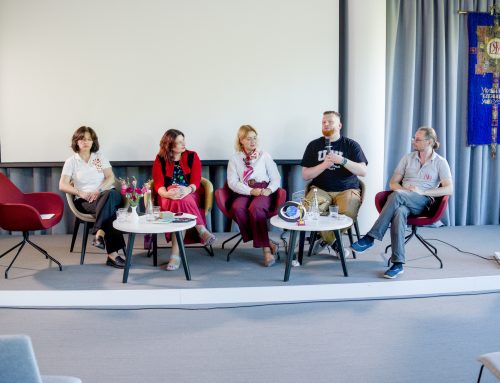
During the discussion about the role of Catholic universities.
Archbishop Borys added that what the University of Notre Dame does is an example for other world universities.
“For example, Notre Dame is effectively decolonizing Slavic Studies by introducing Ukrainian Studies. Russian literature and history is a big topic, and it usually exhausts the field of Slavic Studies in many institutions. Notre Dame is doing something about that. It is actively researching Eastern Europe. It understands its history and is helping to debunk Russian narratives,” said Archbishop Gudziak.